Search This Blog

Monday, October 15, 2012

Follow Up on comment from Article on The Rapture?

Follow Up on comment from Article on The Rapture?

VIEWER WROTE
(This was seen on the net. Any reaction?) Catholics Did NOT Invent the Rapture ! Many assert that the "rapture" promoted by evangelicals was first taught, at least seminally, by a Jesuit Catholic priest named Francisco Ribera in his 16th century commentary on the book of Revelation. To see what is claimed, Google "Francisco Ribera taught a rapture 45 days before the end of Antichrist's future reign." After seeing this claim repeated endlessly on the internet without even one sentence from Ribera offered as proof, one widely known church historian decided to go over every page in Ribera's 640-page work published in Latin in 1593. After laboriously searching for the Latin equivalent of "45 days" ("quadraginta quinque dies"), "rapture" ("raptu," "raptio," "rapiemur," etc.) and other related expressions, the same scholar revealed that he found absolutely nothing in Ribera's commentary to support the oft-repeated claim that Ribera taught a prior (45-day) on The Rapture?

RESPONSE:
I agree, that Catholics did not invent the rapture.  As stated in the footnote that I provided in the article,  Ephraem of Nisibis, in 373 AD preached in the only  known sermon of that time that, "For all the saints and Elect of God are gathered, prior to the tribulation that is to come, and are taken to the Lord lest they see the confusion that is to overwhelm the world because of our sins."  This teaching was not heard of prior to this, nor was it taught in any circles of the apostles.   It wasn't until 1400 years AFTER  Ephraem, there was an allusion to the Rapture as a "doctrine" in a book written in 1788 by a Catholic priest named Emmanuel Lacunza and published in Spain in 1812.   John Darby, a Brethren preacher, taught the Rapture doctrine in 1827. It was William Blackstone who popularized Rapture doctrine in his best seller, "Jesus is Coming." and  The Rapture doctrine entered modern mainstream Christianity with its inclusion in the Scofield Reference Bible.  There is no real history to the Rapture doctrine until the 1800's. The doctrine of the Rapture was not heard of again until the Protestant Reformation and the rise of  Dispensationalism.  In fact, some people believe that the Rapture doctrine was developed to help alleviate some the the problems associated with Dispensationalism, specifically the belief that God deals with Israel and Christians in different ways.  Prior to 373 A.D. there were various theories among Jewish Mystics that taught similar things, all associated with their various sectarian views of the Messiah.

As regards the term "rapture," it cannot be denied that the Latin Vulgate uses the word "raptio" and I am sure that its "translators" were trying to be honest in rendering greek to the nearest latin equivalent. It is however the rabbits that man has run with this, instead of investigating what the truth itself says that has caused the problems. If we would stick to truth instead of theories then we would all be better off.

Jim

Barnabas: An Encourager


Barnabas: An Encourager

A noticeable trait of Barnabas, a prominent Christian in the New Testament, is that he seeks out and assists others. He does this to the point that he is fondly nicknamed Son of Encouragement (Acts 4:37),  The Biblical text highlights this twice with Saul/Paul (9:26-28; 11:25-26), once concerning the vibrant church in Antioch, Syria (11:19-30) and once in connection with his younger kinsman, John Mark (15:36-41). It is also interesting that some of these mentioned are believers who run a bit against the grain of mainstream thought and action. Yet, instead of ostracizing them, Barnabas in the image and tradition of Jesus  deliberately encounters them, listens to them and welcomes them warmly.

Acts introduces Saul as a persecutor of believers (Acts 7:58; 8:1-3; 9:2), to the extent of obtaining letters of authorization from the high priest in Jerusalem to officials in Damascus synagogues authorizing him to bind and arrest new believers and bring them to Jerusalem. It is while he is on this road to Damascus, that he has a literally blinding conversion experience with the risen Lord and becomes a believer himself. Acting upon his new belief, he starts preaching that Jesus is the Son of God in the Damascus synagogues (9:1-20).  His sudden change of character and bold preaching lead his former colleagues and conspirators, to conspire to kill him.The disciples in Jerusalem fearfully avoid him, not believing he really is a believer (9:26). It is here that Luke writes: “But Barnabas took him, brought him to the apostles, and described for them how on the road he had seen the Lord, who had spoken to him, and how in Damascus he had spoken boldly in the name of Jesus” (9:27). It is Barnabas who seeks out Saul, and exhibits personal courage risking his life and reputation. Barnabas brings Saul to the apostles. His ethical attitude of listening, testing what he hears Saul say, and then acting with courage and nobility is consistent in the texts about him.

Some time later,  it is Barnabas among the chosen to go to Antioch, Syria, to investigate the reports of believing Jews and Greeks (Gentiles) worshiping together. He goes and when Barnabas arrives in Antioch, he displays the same characteristics he exhibited in earlier stories: he acts openly, listens and makes ethical decisions. The text says that when he “saw the grace of God, he rejoiced” (Acts 11:23). This shows Barnabas as a man of honorable character. He sees that they, like himself and other Jewish converts, believed and he sees this as evidence of the work and grace of God. He tells the Antioch believers “to remain faithful to the Lord with steadfast devotion” (11:23). Yet, it is here that he seeks out Saul – yet again (Acts 11:25-26). Barnabas’s action shows his humility and discernment. The text indicates that Barnabas’s overriding concerns were the needs of the people and the furtherance of the gospel. Luke gives no indication of jealousy on Barnabas’s part, only an indication of his desire to promote the name of the Lord Jesus and gladly let's Saul teach (Acts 11:26). It must have been a glorious and fruitful time for both congregation and teachers. 

There are several other encounters and mentions of Barnabas in Acts. I encourage you to read them all. In them we find his goodness, faith, big-heartedness, courage, generosity, humbleness, self-sacrifice, open-mindedness, boldness and the fact the he was full of the Holy Spirit – stamped on other believers. 

What would our world be like, if we followed his example?

Jim

Monday, October 8, 2012

The Light of the World?


Consider for a moment Jesus' words - "You are the light of the world. A city set on a hill cannot be hidden.  Nor do people light a lamp and put it under a basket, but on a stand, and it gives light to all in the house.  In the same way, let your light shine before others, so that they may see your good works and give glory to your Father who is in heaven." Mt.5:14-16


This is a portrait of discipleship. Jesus, who IS the light of the world, re-creates us into the light of the world. We are light only because we are in union with Christ, whose light shines into the world through us. As the moon is a luminary of the sun, so we are a luminary of Jesus.  He states in  Jn.8:12, "I am the light of the world. Whoever follows me will not walk in darkness, but will have the light of life."  God speaks the light of Jesus into our hearts, and His light shines through us that we are like stars in the universe that point the whole human race toward real life (Ph'p. 2:15-16).

With this truth, our focus must always be on the light, humbly trusting Jesus to reveal His light through us. Our influence and visibility is a result of who lives in us. We are merely a steward of influence and visibility. Either we will be a luminary for God, or we will reflect the Devil (Jn.8:47). That said, we should get our egos out of the way and let Jesus work through us (Gal.2:20). Only God can measure the significance of your influence and visibility. You may influence one person who will then influence the world. Our focus must be on following Jesus wherever He leads.

This raises the question of how are you using your influence to shine the light of Christ? Have you asked God to humble you as you consider how He has placed you in life to influence for his glory?  We should not cringe when things do not go our way or fret because I didn't get what I wanted today. If I am living for God's glory, then what I want does not matter. If it didn't happen the way I wanted, then it is because either their was something ahead that God foresaw that He preserved me from, or it simply was not His will. 

Pray for his wisdom and discernment as you follow Jesus’ example and direction for your life that He leads you into things that will allow Him to use you for His glory.

Jim


Sunday, October 7, 2012

New Assyrian town discovered in northern Iraq | Ferrell's Travel Blog


New Assyrian town discovered in northern Iraq


'via Blog this'


An article in Al Arabiya informs us that foreign archaeologists have discovered a new Assyrian site near the Arbil (Erbil) city center. Arbil is located southeast of the modern Kurdish city of Mosul, the area of Assyrian cities such as Nineveh, Calah, and Khorsabad.
Archeologists working in northern Iraq have discovered a new Assyrian site in the vicinity of the historic Arbil city center, the head of the antiquities office in the Kurdish Province of Arbil, Haydar Hassan, was quoted as saying in an Iraqi newspaper.
The Assyrian civilization flourished in northern Iraq between 1000-700 B.C., archeologists were led to discover the site when they exhumed a burial ground, complete with mud brick grave heads.
To further unearth this site the foreign archeological team had to study and remove two more layers of civilization under which the Assyrian structure was buried, according to a report published by Iraq’s al-Zaman on Monday.
The excavations have shown that the Assyrian graves were covered by remains belonging to the Sassanid Persian Dynasty that ruled Iraq before being dislodged by Muslim Arab tribes from the Arabian desert in the 7th century A.D., said Haydar Hassan.
So far only the brick arches and corridors of the Assyrian layer have been brought to the surface.
Although archaeological teams from Italy, the U.S., Germany, Holland, Poland and Greece are currently working in northern Iraq, Hassan did not say which foreign archaeologists were working on the newly discovered Assyrian site in Arbil.
The article may be accessed here.
Assyria was a threat to Israel from 853 B.C., when they defeated Ahab at the battle of Qarqar, until the LORD defeated them at Jerusalem in 701 B.C., and the final defeat at the battle of Carchemish in 605 B.C. The prophet Isaiah warned the people of God about the Assyrian threat.
Therefore thus says the Lord GOD of hosts: “O my people, who dwell in Zion, be not afraid of the Assyrians when they strike with the rod and lift up their staff against you as the Egyptians did. For in a very little while my fury will come to an end, and my anger will be directed to their destruction.  (Isaiah 10:24-25 ESV)
The photo below is of the Assyrian king Tiglath-Pileser III (745-727 B.C.). It was discovered in the central palace at Nimrud, and is now displayed in the British Museum.Tiglath-Pileser III is mentioned in 2 Kings 16:7, 15:29, and a few other references.
Who knows what new things may come from other cities yet to be excavated?
Tiglath-Pileser III, king of Assyria, from Nimrud's central palace. Now displayed in the British Museum. Photo by Ferrell Jenkins.
Tiglath-Pileser III, king of Assyria, from Nimrud. Now displayed in the British Museum. Photo by Ferrell Jenkins.

Monday, October 1, 2012

Adultery & Wrongful Divorce - Controlling Our Fleshly Desires


Other Scriptures you may wish to research with respect to this subject:
Gen.2:18-25; Deut.24:1-4; Mt.19:1-12; Mk.6:14-29; Mk.10:1-12; Lke.16:18; 
Rom.7:1-4;  1 Cor.7:1-40; Eph.5:22-33; Col.3:18,19; 1 Pt.3:1-7

This is another complex subject, but not from God's standpoint. With God - it is simple - DON'T DO IT!  However, man has a way of messing things up, and so it has been for a very long while 
with this particular moral aspect of life. From committing the act to trying to reason it out, man has been more inventive in finding ways to try to go around what God says, excusing it, dismissing it or outright avoiding it. 

Jesus makes a point in Matt.19:8 "...from the beginning it was not so."  With regard to legislation of it, God first speaks it in the law in Ex.24:14. It is further elaborated on in Dt. 24:1-4 and in the Law he makes provision for divorce or disollution of a marriage. Jesus elaborated on this in  Mt.5:27-30 "Ye have heard that it was said, you shall not commit adultery,  but I say unto you..."  So, let's look at the core of the matter according to Jesus. 

The meaning of adultery from  the Hebrew is to commit adultery, always with the spouse of another(1).  The Greek word means to commit adultery with, have unlawful intercourse with another's spouse (2).  Yet, Jesus elaborates further "...that every one that looketh on a woman to lust  after her hath committed adultery with her already in his heart." This was in contrast to the common Jewish teaching in their Mishnah where one Rabbi Akiba explains, "[he may divorce her] even if he finds another woman more beautiful than she is, as it  says, it cometh to pass, if she find no favour in his eyes."  Notice that Jesus states that adultery is "already" in the heart when one looks upon another to lust after them. The intent of the looking is "..to lust after..(3)" to lust after, covet, used of those who seek things forbiddenThis reveals the intent of heart behind the looking, which contradicts three particular scriptures (Ex.20:17; Deut.5:21; Prov.5:15-19).  "...adultery already..."  - Here is the further intent of the looking. It is not looking  because the other is an attractive person. The looking is with lust to the intent of imagining sexual relations with them in the mind (i.e.,heart).  His teaching regarding this if you find yourself in this situation? Control your desires and keep them pure.And when these tendencies arise in your heart and life, get at the root of what is causing the sinful desire and purge it from you. Better to do without the "pleasure" thought to be given by such desires, than to be cast into hell.

But what about divorce? Jesus comments in Mt.5:31,32 "It was said also, Whosoever  shall put away his wife, let him give  her a writing of divorcement but I say unto you..."  Jesus is not disputing here, the statement made by Moses in Dt.24:1-4. He is disputing the Rabbinical interpretation (4) and teaching regarding Dt.24:1-4.  He elaborates "...that every one that putteth away his wife, saving for the cause of fornication, maketh her an adulteress and whosoever shall marry her when she is put away committeth adultery."  Then as now, there were people who wanted to divorce for just any reason, and the teaching of the Rabbi's condoned it.  Jesus in following up with the fact that God DOES NOT LIKE this, states that there is one cause that is "allowed."  Fornication(5) is "illicit sexual intercourse, adultery, fornication, homosexuality, lesbianism, intercourse, with animals etc."  What can we glean from Jesus' teaching here?  Jesus teaches that righteousness and love do not look beyond one's spouse, to lust after another.  In the same respect, righteousness and love does not put away a spouse unless immorality has been involved. Righteousness and love, honor commitments and responsibilities.  The warning that He gives is that when I hold no honor for the commitments or responsibilities I have made, I not only place stumbling blocks in my own path, but, may very well cause another to sin as well.

Who is right? Who is wrong? Who is an innocent party - who is not? I do not have all of the answers, to all situations. This can only come, when you take your particular situation and compare it to the scripture's teaching.  This study shows us that what is sin on the surface, starts with minute fissures beneath. The admonition of the passage is more with regard to keeping our hearts and actions pure. If the thoughts and actions are stopped before they begin, then we do not have to worry about the outcome.

Jim
________________________________________________
REFERENCE CITATIONS
(1) Strong's Hebrew Dictionary, Word # 5003 na'aph, Strong's Exhaustive Concordance by James Strong, S.T.D., LL.D., 1890.
(2.) IBID Strong's Greek Dictionary Word # 3431 moicheuo
(3.) IBID Strong's Greek Dictionary Word # 1937 epithumeo 
(4) Beth Shammai say: a man should not divorce his wife unless he has found her guilty of some unseemly conduct, as it  says, because he hath found some unseemly thing in her. Beth Hillel, however say [that he may divorce her] even if she has merely spoilt his food, since it says, because he hath found some unseemly thing in her. R. Akiba says [he may divorce her] even if he finds another woman more beautiful than she is,  as it  says, it cometh to pass, if she find no favour in his eyes." .
(5)  Strong's Greek Dictionary Word # 4202 porneia, Strong's Exhaustive Concordance by James Strong, S.T.D., LL.D., 1890.

Saturday, September 29, 2012

Titus Flavius Josephus and the Prophet Jeremiah – Biblical Archaeology Society

Titus Flavius Josephus and the Prophet Jeremiah – Biblical Archaeology Society:

'via Blog this'


Titus Flavius Josephus is best remembered as an unparalleled chronicler of first-century C.E. Jewish history. His legacy also includes a military record marked by the betrayal of his peers and capitulation to the Romans. As a commander in the Jewish revolt, Josephus attempted to persuade his companions to open the gates of Yodfat for the Romans, and when the city fell, he reneged on the group’s suicide pact and personally surrendered. After the destruction of Jerusalem, Titus Flavius Josephus lived as a Roman citizen in the emperor’s palace, enjoying the luxurious life of a dignitary and scholar.
Josephus’s repeated calls for surrender to the Romans have been labeled as betrayal. In the September/October 2012 issue of Biblical Archaeology Review, distinguished scholar Avisahi Margalit contrasts the historian’s tarnished reputation with that of the prophet Jeremiah. The prophet Jeremiah also urged total surrender to a militarily superior foe, the Babylonians. He tried to escape Jerusalem, and, much like Titus Flavius Josephus, was accused of trying to defect. Avisahi Margalit asks: how is it that the Biblical prophet Jeremiah is revered while Josephus is criticized?
Avishai Margalit
Avisahi Margalit writes that “Josephus offers two kinds of defenses: defense of creed and defense of his people.” Josephus portrayed the zealots as irrational while defending the majority of Jews and the Roman dynasty, conveniently omitting the widespread support for the revolt and the atrocities committed by the Romans. Margalit writes that Jeremiah is also a historian, but “his appeal to history is not out of an interest in human affairs as such, but rather in history as a source of obligations to God. The religion of the Bible is, broadly speaking, a historically based religion; the primary arena of the Bible is history; the divine manifestation is set essentially in history.”
Neither Titus Flavius Josephus nor the prophet Jeremiah considered the creation of a Judean vassal state to be idolatry, and both took it upon themselves to warn their people of the superior military force of their enemies. Yet Avishai Margalit states that, “Josephus was tainted by his relation to power; Jeremiah was willing to risk everything. Josephus’s relation to power should not disqualify him as a witness in the court of history but it does disqualify him as a moral witness: a moral witness is never in the service of the ruling power.”

Wednesday, September 26, 2012

Acts 13 — Photo Illustrations # 2 | Ferrell's Travel Blog

Acts 13 — Photo Illustrations # 2 | Ferrell's Travel Blog:

'via Blog this'


Acts 13 — Photo Illustrations # 2

During the trip to Israel I got a little behind in the photo illustrations for the chapters of Acts.
When we come to Acts 13 and 14, there are so many places to consider that it could take weeks to cover them all in detail. In fact, if you use the search box you will see that we have posts on most of the places mentioned in these chapters.
It seems that Paul and Barnabas did not stop to preach in Perga on the outgoing portion of the first journey. The text says, almost casually, that “going on from Perga, they arrived at Pisidian Antioch” (Acts 13:14).
Here we have one of the longer sermons of the book of Acts — Paul’s sermon in the Jewish synagogue. While it appears that we have a vibrant Jewish community in Pisidian Antioch, we also find a receptive Gentile audience. When the Jews rejected the message of the risen Christ, Paul and Barnabas said,
“we are turning to the Gentiles.” (Acts 13:46 ESV)
Pisidian Antioch was a city of numerous idol temples. There was a sanctuary or temple dedicated to the Emperor Augustus (30 B.C. – A.D. 14) built by Tiberias (A.D. 14-37).
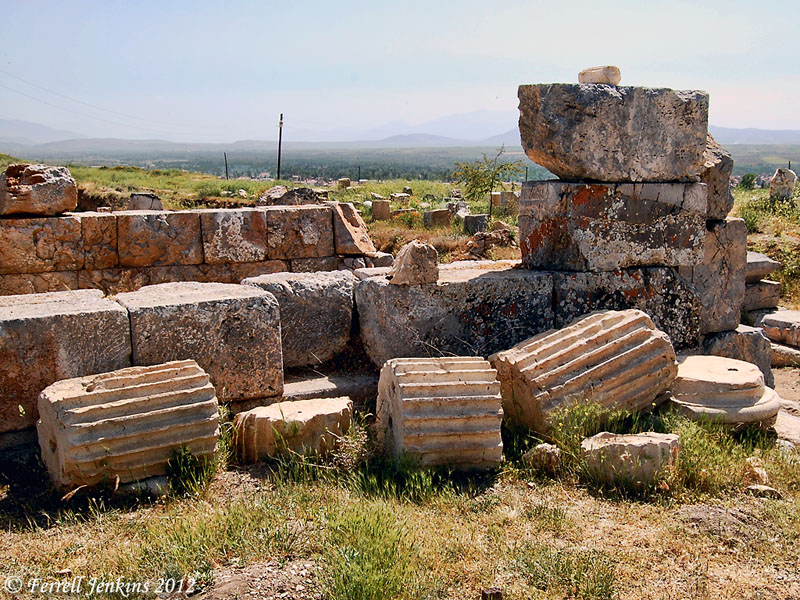
Ruins of the Augustus Imperial Sanctuary at Pisidian Antioch. Photo by Ferrell Jenkins.
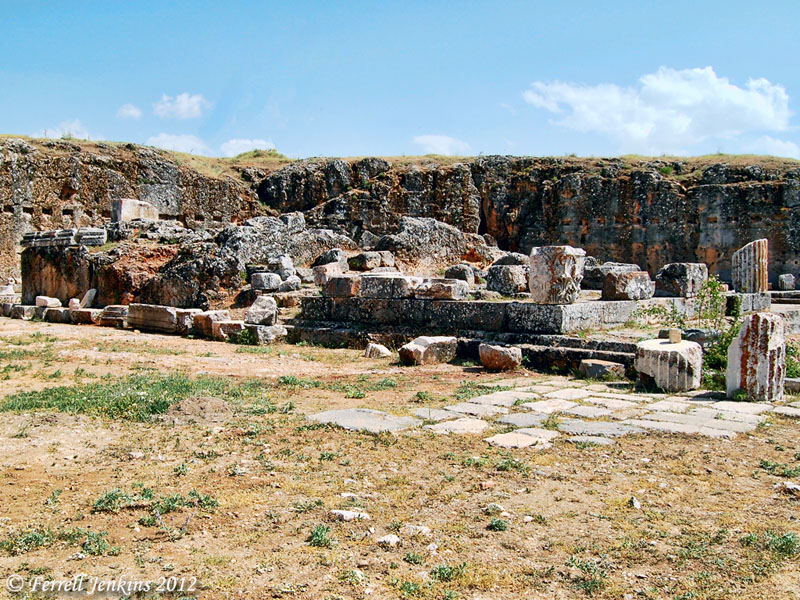
The foundation of the sanctuary is cut from the solid bedrock.
The Augustus Imperial Sanctuary at Pisidian Antioch. Photo by Ferrell Jenkins.
Peter Walker describes the temple,
Beyond the propylon was a large, semicircular courtyard, surrounded by colonnades, the eastern part of which was cut out from the hill-side’s rock. And standing in the centre, towards the back, was the sanctuary of Augustus’ temple. Though quite small – some 15 by 30 feet (4.5 x 9 m) – it was set on a high foundation of natural rock and approached by a further twelve steps. Antioch’s residents were expressing in impressive fashion their gratitude to the emperor for their city’s increased prestige under his rule. However, for Paul it demonstrated the daunting challenge ahead. What room would there be for his own message, focused on a rival world-ruler, in a city where this imperial cult was evidently growing at such a pace? (In the Steps of Paul, 87,89).
Maps. In your study of Acts you might enjoy the use of the Digital Map of the Roman Empire available here. This map, based on the Barrington Atlas, includes the road system. Because the maps show the terrain, you can get some concept of the difficulties encountered by Paul and his companions as they traveled from place to place.
Thanks to Dr. Rasmussen for the lead to this map.