Search This Blog

Monday, July 9, 2012

Reverend, Pastor, Bishop, Father


“Pastor,” a simple word used commonly or loosely today to refer to a “member of the clergy.”  No one seems to question its origin anymore and no one questions whether it is even Biblical to use. It’s just a common thing.  Other descriptors that fall into this pot are “Reverend,” “Father,” “Bishop” etc.   Some say, “they’re just titles” and that we shouldn’t make too much of it and just go with the flow.

First, Jesus said  Mt 23:9,10  "Do not call anyone on earth your father; for One is your Father, He who is in heaven. Do not be called leaders; for One is your Leader, that is, Christ.”  The reason for this is because Jesus saw the same thing happening in His day and he states – DON’T DO THAT!  There should be NONE in GOD’S HOUSE that seek elevation over another.  Well, if we aren’t to do that, then why do people do it?  The simple answer is that people don’t want to follow what God says. But, so that you can understand the history behind this in our own times, let’s do a little digging.

Even in the days of the Apostles, Paul warns  “For the time will come when they will not endure sound doctrine; but after their own lusts shall they heap to themselves teachers, having itching ears…” 2 Tm.4:3 .   Likewise, Peter warns, “Knowing this first, that there shall come in the last days scoffers, walking after their own lusts”  2 Pt. 3:3.  One of the first of these deviations at the turn of the 1st and 2nd centuries, were local congregations were led by bishops, elders and presbyters leadership were overlapping or indistinguishable (Cambridge History of Christianity, vol. 1, 2006). While during that time there was probably no single "monarchical" leader before the middle of the 2nd century. However, this gave rise to “Eucemenism” derived from Greek οἰκουμένη (oikoumene), which means "the whole inhabited world", and was historically used with specific reference to the Roman Empire. It refers to the idea of a Christian unity in the literal meaning: that there should be a single Christian Church upon the earth, and if one church.  This gave rise to the first Ecumenical Council in Nicea under Roman Emperor Constantine to adapt a single creed under a nationally united “church.”  This was in 325 A.D. and by 606 A.D. the concept of a “Universal Bishop” had taken root and the “Pope” is born. Since that time, the New Testament concept of God’s Body has been shredded into an unrecognizable shadow.  Men have inserted their own words and will for God’s.   With the translation of the Bible into English which came with the split of the Church of England from the Catholic Church, King James in his development of the King James Version Bible, in rule #3 of his Rules of translation states that the “Ecclesiastical Terms” would not be changed to their original words used. The word Church would not to be translated Congregation, etc.  The reason behind this was for the support for ecclesiastical hierarchies to be written into the KJV bible (through the unbiblical concepts 'ranks' and 'ordination' were "written in", without any basis for that in the Hebrew or Greek text-JH).  As “Divine Head” of the Church of England,  James wanted the control “church” and subjects to be by a hierarchical system and therefore subject to the laws of England. He could not have a translation that allowed people to believe that any authority belonged to the common people.  As such, ”Church” was used in place of Congregation or Assembly, “Pastor” was used in place of Shepherd, the transliteration “Baptize” is used in place of Immerse , Hell is used indiscriminately in places where the original languages used “Grave”, “Realm of the Dead” etc. King James I in effect directed “that the translation adopt language supportive of episcopacy” (Historical Dictionary, p. 174).

Some might say that this Ecclesiasticism is right and taught in the scriptures (1 Tm.3; Tit.1).  Yet, it behooves us again to look at the term “office.”  “Office” signifies to us a position of power, dominance with underlings to which we issue orders.  Yet, if you examine the context of the statement, it is describing FUNCTION.  What is the FUNCTION of BISHOPS, ELDERS, OVERSEERS, PRESBYTERS?  Guidance, example, character, experience, wisdom, clear thinking and able teacher (1 Tm.3).  There is not anywhere in the text or context that any of these functions are spoken of as dictators, dominators, legislators or givers of God’s law.  If anything, they are SERVANTS, in the function of guidance, example, character, experience, wisdom, clear thinking, leadership and teaching.  In fact, 1 Pet.5:8 states that they are NOT to LORD over God’s heritage. It is NOT a title, office, position, that allows any men or man to “make decisions for the church.”  Theirs is a cooperative function WITH the body to operate together as a FUNCTIONAL unit to bring God glory and bring its people to building itself up in love (Eph.4).
  • Reverend? -  Scripture SAYS Psa 111:9  He sent redemption unto his people: he hath commanded his covenant for ever: holy and reverend is his name
  • PASTOR? - only in Guidance, example, character, experience, wisdom, clear thinking and able teacher (1 Tm.3)
  • FATHER? Mt 23:9,10  "Do not call anyone on earth your father; for One is your Father, He who is in heaven. Do not be called leaders; for One is your Leader, that is, Christ.” 

There IS NO CLERGY in God’s book!  There is no DOMINATING, DICTATING or anything like it by MEN!  Christ is the Head of the Congregation, it is HIS, bought with HIS BLOOD, and all knees bow to HIM!   I know that people mean well when they refer to someone as “Pastor.” But, this does not make it right.  If we are going to use statements like that, then use them Biblically  - or not at all.

Jim

Saturday, July 7, 2012

Photography in the Israel Museum. Can it be? | Ferrell's Travel Blog

Photography in the Israel Museum. Can it be? | Ferrell's Travel Blog:

'via Blog this'


Carl Rasmussen, author of the Zondervan Atlas of the Bible, reports here on hisHolyLandPhotos’ Blog that he took a group to the Israel Museum today and that photography (without flash) was allowed in the archaeology section. Prof. Rasmussen concludes, “A new era has begun!!”
Several times I have criticized museums that do not allow photography of archaeological artifacts.
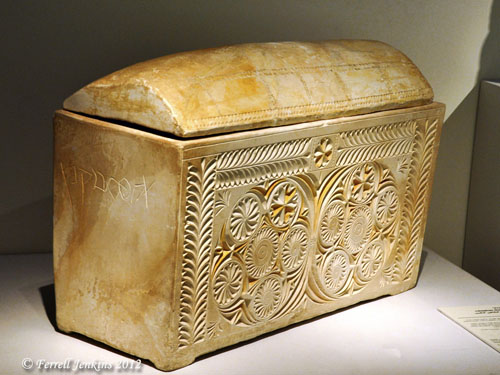
A photo such as the one below can be helpful to teachers who prefer to have their own photos for use in teaching. The highly decorated Caiaphas Ossuarywas discovered during the construction of a water park in Jerusalem’s Peace Forest. The remains of six individuals were found inside the ossuary including that of a man about 60 years of age. The name of Caiaphas is inscribed on both ends of the “bone box.” The single line visible in this photo is translated “Joseph son of Caiaphas.” Many scholars believe that this is likely the high priest Caiaphas before whom Jesus stood prior to His crucifixion.
So Annas sent Him bound to Caiaphas the high priest. (John 18:24 NAU)
The Caisaphas Ossuary in the Israel Museum, Jerusalem.
The Caiaphas Ossuary in the Israel Museum, Jerusalem. Photo by Ferrell Jenkins.

Peering Into The Darkness | Spreading Joy

Peering Into The Darkness | Spreading Joy:

'via Blog this'


Darkness is scary.  The unknown is scary.  Stepping into the darkness, not knowing what to expect, not being able to see is, at best, difficult.
While being surrounded by darkness we are often paralyzed in fear and are rendered powerless to move with confidence.  But, remember, as long as we are moving forward, we are making progress.
We all have seasons of darkness, fears, trials and issues that we feel will overpower us and shatter our world.
Let’s take a closer look into the darkness that can be more intimidating that we can imagine.
What do we see in the darkness?
  • Nothing and in abundance
  • Fear
  • Intimidation
  • Hopelessness
  • Despair
  • Loneliness
  • Danger
  • Enhanced Pain (pain is always worse at night isn’t it?)
  • Discouragement
  • Shame
  • Guilt

There are many more things that we see in the darkness and those things often shield our eyes to the positive things that are also in the darkness.
It’s so much easier to see the negative, to dwell there and to let the discouragement of it take over our hearts.    But peering into the darkness doesn’t have to leave us paralyzed in fear, or feeling hopeless.
Have you considered anything positive lurking in the darkness?
May I remind you that GOD is right there with us in the darkness?  HE Lives in the darkness with us and if we focus on His light during the darkest day, we’ll make it through stronger, wiser and more faithful than we can ever imagine.
I know just how frightful and discouraging dark trials are.  I know firsthand financial troubles, health issues with children and how the sting of unemployment affects families.  I know the loneliness and fear that can consume your heart during those times of complete darkness.  I know how tightly discouragement holds on to you, rendering you powerless to even lift your head sometimes.   I know the pain and grief of families being torn apart and loved ones dying, never to hear their sweet voices or see their precious smile again.  I know how guilt and shame leaving you feeling like you have no right to blessings.  I know how the pain of any situation is enhanced in the darkness.
But….
I also KNOW the ONE who is right beside me as I’m peering into the darkness!  As I’m traveling through the darkness, HE doesn’t mind living there to protect me, to strengthen me and to guide me.
Our darkest days are no surprise to HIM.  Our tears of pain, aches of discouragement and feelings of failure are no surprise to Him.  Our anger and questions screamed at the top of our hearts because we simply don’t understand does not cause Him to worry or wonder what will happen.

Our darkness is another way for our Lord and Savior to remind us that HE LIVES! HE LIVES in our darkness along side of us!

The next time you find yourself peering into the darkness, and make no mistake…you will, remember that God lives there too.
When you peer into the darkness KNOWING God is with you, you’ll see:
  • Peace that surpasses all understanding
  • JOY unspeakable
  • Light that brightens up the darkest of nights
  • Hope, never ending
  • Mercy, renewed each day
  • Grace, marvelous grace
  • Courage, because your Father has you
  • Comfort, knowing you are not alone
  • Faith, because HE will never leave you

There are many other positive things that are waiting for us in the darkness.
Would you share your thoughts of what you are going to look for the next time your world is engulfed in complete darkness?
Will you share the Bible verses that help you to see a flicker of light and hope when there seems to be no end to the trial?
Will you encourage the hundreds of others who will read this with the wisdom and faith that you’ve gained while peering into the darkness?
I hope that you will do so in the comment section below.
I also hope that as you are wandering around in the darkness that you’ll start to see the powerful things that live there too.

Thursday, July 5, 2012

BiblePlaces Blog: Excavations and Museum at Sidon

BiblePlaces Blog: Excavations and Museum at Sidon:

'via Blog this'


The Daily Star (Lebanon) reports on the continued excavations inthe port city of Sidon.
Excavations led by a delegation from the British Museum at the Frères’ archaeological site in the old city of Sidon unearthed more important antiquities during their 14th year, it was revealed Tuesday.
Preparations also got under way for the construction of a museum to display the findings at the site. The construction is due to begin in September.
Discoveries at the site since excavations began in 1998 have revealed artifacts from the Early Bronze Age, which began around 3,000 B.C., through to the Iron Age, which covered around 1,200-539 B.C.
Among the latest discoveries was a particular type of Phoenician architecture, which the archaeologists said was not commonly found in Lebanon, consisting of stones cut for the construction of walls or floors.
Over 50 amphorae were also found, as well as a stunning Attic vase, depicting two riders going to war wearing white tunics and holding spears.
More details of the discoveries are given in the full story.
Sidon, Sea Castle and causeway, adr090508658
Sidon, Sea Castle and causeway (photo source)
Sidon is mentioned many times in the Old and New Testaments. Some passages indicate that Sidon was intended to be the northern border of Israel (Gen 10:1949:13Judg 1:312 Sam 24:6), and in the days of Zerubbabel cedars were imported for the Second Temple (Ezra 3:7). Both Jesus and Paul visited the city or area of Sidon (Matt 15:21Acts 27:3). Though prophets condemned the city (Isa 23:2-12Jer 47:4Ezek 28:21-22Joel 3:4), Jesus declared that Sidon would fare better on the day of judgment than Chorazin and Bethsaida (Matt 11:21-22).
HT: Jack Sasson

Missional Challenge: Church Planters: Don't Dream of Starting a Church!

Missional Challenge: Church Planters: Don't Dream of Starting a Church!:

'via Blog this'

Jesus never started a local church or commanded anyone to start churches. Jesus made disciples and instructed His disciples to make disciples. Churches are communities of disciplemakers, not places to worship. Churches are the natural outcome of disciples making disciples. 

Dan Grider training church planters to be disciplemakers!


What's your dream for the future?

If you are a church planter, don’t be dreaming of how you are going to start a church.

Instead, start dreaming of how you are going to obey Jesus by making disciples who make disciples.

If you do this well, you’ll find churches will be multiplied as you go. 

Tuesday, July 3, 2012

Cheering when God is unexpectedly mentioned in a summer blockbuster movie. | Stuff Christians Like – Jon Acuff

Cheering when God is unexpectedly mentioned in a summer blockbuster movie. | Stuff Christians Like – Jon Acuff:

'via Blog this'


If you haven’t seen the Avengers, this is a spoiler alert:
Captain America is in the movie.
That’s not a spoiler? He’s on the poster and in all the trailers? Fair enough, but if you did see it and you’re a Christian, you undoubtedly cheered in your seat at a certain scene.
You know the one I’m talking about.
Scarlet Johannsen, the criminally unarmed female lead (seriously she’s standing next to the Hulk and Thor with a tiny handgun), warns Captain America about getting in between Loki and Thor. She tells him he’s over his head because they are both “gods.” And Captain America responds with this:
Cue quiet cheer in my seat in the theater. Yay! A God shout out! Way to go movie. Or Marvel. Or Stan Lee. Yay all of you!
Granted, I didn’t think much was going to come of that. I didn’t anticipate an altar call at the end of the movie, me maybe baptizing a few people in the soda fountain in the lobby, popcorn raining down on us like delicious manna.
I’m not that silly. I know that’s not going to happen. I went on watching the movie with nary a thought about the Christian implications. Until …
that other scene with the Hulk. You know the one I’m talking about. It’s the one I watched 100 times on YouTube. I think I might have even stood up a little in the theater when he muttered “Puny gods.”
Granted, the Hulk didn’t then say, “There’s only one Alpha and Omega, He gives and takes away, blessed be the name …” but it’s close enough for me.
Is that enough to turn the Avengers into a sermon series, a la “The Matrix” and “Gladiator.” Maybe not, but there’s definitely enough in there for a Vacation Bible School Avengers theme.

Monday, July 2, 2012

BiblePlaces Blog: Samson Mosaic Discovered in Galilee Synagogue

BiblePlaces Blog: Samson Mosaic Discovered in Galilee Synagogue:

'via Blog this'


Samson Mosaic Discovered in Galilee Synagogue


A colorful mosaic depicting Samson and a pair of ignited fox tails has been discovered in the excavation of a Byzantine-era synagogue in Galilee. The depiction of Samson is accompanied by two female faces and a Hebrew inscription that speaks of rewards for those who do good.
The Israel Antiquities Authority has issued a press release:
Huqoq is an ancient Jewish village located approximately two to three miles west of Capernaum and Migdal (Magdala). This second season of excavations has revealed portions of a stunning mosaic floor decorating the interior of the synagogue building. The mosaic, which is made of tiny colored stone cubes of the highest quality, includes a scene depicting Samson placing torches between the tails of foxes (as related in the book of Judges 15). In another part of the mosaic, two human (apparently female) faces flank a circular medallion with a Hebrew inscription that refers to rewards for those who perform good deeds.
"This discovery is significant because only a small number of ancient (Late Roman) synagogue buildings are decorated with mosaics showing biblical scenes, and only two others have scenes with Samson (one is at another site just a couple of miles from Huqoq)," said Magness, the Kenan Distinguished Professor in the department of religious studies in [University of North Carolina at Chapel Hill] College of Arts and Sciences. "Our mosaics are also important because of their high artistic quality and the tiny size of the mosaic cubes. This, together with the monumental size of the stones used to construct the synagogue's walls, suggest a high level of prosperity in this village, as the building clearly was very costly."
The site is being excavated by Magness along with David Amit and Shua Kisilevitz of the Israel Antiquities Authority.
The IAA has released three photos (direct link) of the mosaic floor, but none of them show Samson or the fox tails. Amit describes the scene: the "mosaic contains a description of the biblical Samson and two pairs of foxes with a flaming torch connecting their tails." The story is recorded in Judges 15:3-5.
See caption.
Jodi Magness, David Amit, and Shua Kisilevitz, co-directors of the Huqoq Excavation, with the mosaic. Photo by Jim Haberman.
See caption.
Huqoq mosaic with female face and inscription. Photo by Jim Haberman.
See caption
Female face in Huqoq mosaic. Photo by Jim Haberman.
The story is reported by the Jerusalem PostArutz-7, and others. A volunteer working at the excavation this summer posted his experiences on a blog, but he does not mention the synagogue or Samson.