
Search This Blog

Thursday, February 9, 2012

Jesus and the Moneychangers | Ferrell's Travel Blog

Jesus and the Moneychangers | Ferrell's Travel Blog:

'via Blog this'

Jesus and the Moneychangers

We noted in a previous post that there are two accounts of Jesus cleansing the temple. By this we mean the temple precinct (the hieron), not the sanctuary where only priests were allowed (the naos). For the first account, early in his ministry, see John 2:13-25. The second account, toward the close of his ministry, is recorded in Matthew 21:12-13; Mark 11:15-18; and Luke 19:45-48.

Artist Balage Balogh illustrates the scene of Jesus and the Money Changers. See more of his work at Archaeology Illustrated here.
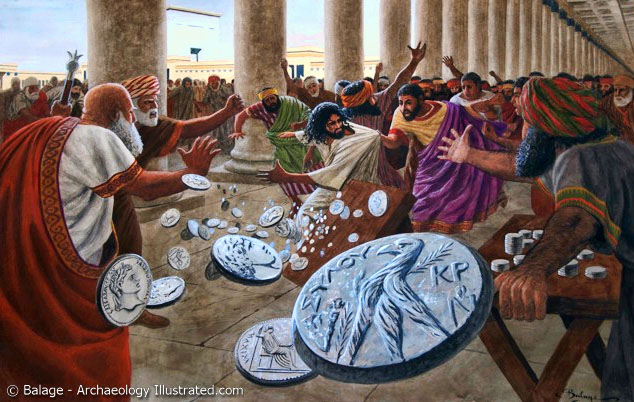
Jesus and the Money Changers. Balage Balogh, Archaeology Illustrated.

Jesus and the Money Changers. Balage Balogh, ArchaeologyIllustrated.com.

The biblical account also mentions the animals and birds that were for sale to those coming to Jerusalem to worship (John 2:16; Matthew 21:12).

Money changers. (English versions use moneychagers, money-changers, andmoney changers.) The Jews normally would not bring the foreign money as an offering to the temple. The money had to be changed into the half-shekel of ancient Israel. This would necessitate money changers. Those who have traveled to foreign countries understand that money changers are common and necessary. Alfred Edersheim, who wrote a book on The Temple: Its Ministry and Services, pointed out that the total sum derived annually from the Temple tribute was large. The money changers were simply in the wrong place.

It is generally held that the coin used by the Jews for the temple tax was the Tyre shekel, which after 19 B.C. was most likely minted in Jerusalem (cf. Hendin,Guide to Biblical Coins, 175).

A hoard of coins including Tyrian Shekels, half shekels, and denarii bearing the image of Roman Emperor Augustus (30 B.C.– A.D. 14) was found a few years ago at Ussifiyeh (Isfiya), a Druze village on Mount Carmel.

Ussifiyeh hoard of coins including Tyrian Shekels. Eretz Israel Museum.

Ussifiyeh hoard of coins including Tyrian Shekels. Photo by Ferrell Jenkins.

The information sign in the Eretz Israel Museum in Tel Aviv says,

The hoard probably represents a delivery of Temple tax intercepted and hidden away due to the events of the Jewish War which broke out in 66 C.E.

Monday, February 6, 2012

You, God, and Quiet Moments


“The LORD does not look at the things people look at. 
People look at the outward appearance, but the LORD looks at the heart.”  
1 Samuel 16:7

What is the right attitude to have when you and God have your quiet moments together?  This is an interesting question.  Job's quiet time of "mourning" his existence was to lash out at God. He did not deny Him and maintained faith in Him, yet, he let God know that he did not like what was happening to Him.  Others come to their quiet time and don't see God at all. Still others find quiet moments exhilarating times when God speaks loudly and clearly from His Word.   What about for you? How do you approach your time with God in your quiet moments?

1.  Be eager to come and hear. Remember, you’re meeting with God. God has always invited and wanted man's fellowship, to "walk with Him in the Garden in the cool of the day (Gen.3:8). You should want to have a good time  with him and receive a blessing from doing so.  Acts 10:33 "Now therefore we are all here in the presence of God to hear all that you have been commanded by the Lord." 

2.  Come with reverence. Even though you are "just praying" and "just studying the bible"  don't forget that you are coming into the presence of God. You need to prepare your heart by being still before him.  Psa 46:10  "Be still, and know that I am God. I will be exalted among the nations, I will be exalted in the earth!" 

3. Come alert. If you made an appointment with someone to come and talk with them about something important, you would be insulted if in the process of the conversation, they fell asleep!  Jesus even talked with His disciples about this the night before his trials and crucifixion!   Psa 5:3  "O LORD, in the morning you hear my voice; in the morning I prepare a sacrifice for you and watch. 

4. Come with a heart to obey.  In the passage stated above, Acts 10:33 and Jn.4:42 these people came with a heart not only to hear what God had to say, but they came with the intent that when God spoke - they would do!  We too need to tell the Lord we have already decided we are going to say “yes.”  Mar 11:24  Therefore I tell you, whatever you ask in prayer, believe that you have received it, and it will be yours. 

Author Bruce Wilkinson states, "A moment of gratitude makes a difference in your attitude."  Have a good attitude before you when you come before God and you can expect a good result from your quiet time.  

Jim

Sunday, February 5, 2012

The Kings of Babylon and Bible History | Ferrell's Travel Blog

The Kings of Babylon and Bible History | Ferrell's Travel Blog:

'via Blog this'

The Kings of Babylon and Bible History

It is important as we study the Bible that we have some understanding of the historical background and setting of the events described. There is no place where this is more obvious than in the Book of Daniel.

Daniel and his friends were taken to Babylon by the new king of the Neo-Babylonian Empire, Nebuchadnezzar. It was during the early reign of Nebuchadnezzar that Daniel’s friends were thrown into the fiery furnace (Daniel 3).

Daniel was cast into the den of lions during the reign of the king Darius the Mede, who gained control of Babylon in 539 B.C. Thus, at least 66 years pass from the time Daniel was taken to Babylon until he was put in the den of lions.

To put this is practical terms for modern readers, the events mentioned above are as far apart as events during the presidency of Harry S. (1945-1953) and Barack Obama (2009–).

The Neo-Babylonian Empire came to power in 626 B.C., and fell in 539 B.C. Perhaps this list of the kings of Babylon will be helpful in your study. The rulers mentioned in the Bible are listed in bold type.

  • Nabopolassar — 626-605 B.C.
  • Nebuchadnezzaar — 605-562 B.C.
    • 2 Kings 24; Daniel 1-5; et al.
  • Evil Merodach — 562-560 B.C.
    • 2 Kings 25:27; Jeremiah 52:31.
  • Nergal-Sharezer — 560-556 B.C.
    • Jeremiah 39:3, 13, when he was an official of Nebuchadnezzar.
  • LabaÅ¡i-Marduk — 556 B.C. (ruled only 9 months)
  • Nabonidus — 556-539 B.C. Not named in the Bible. His son, Belshazzar, served as co-regent the last ten years of the reign.
    • Daniel 5-8.

The names and dates above have been summarized from the article by the late D. J. Wiseman in The New Bible Dictionary (3rd edition).

Map of world showing Babylon in the center. British Museum. Photo: Ferrell Jenkins.

Map of world showing Babylon in the center. British Museum. Photo by Ferrell Jenkins.

Perhaps later we will be able to describe in more detail the Biblical events during the Neo-Babylonian Empire.

Wednesday, February 1, 2012

Nabopolassar, father of Nebuchadnezzar, destroyed Nineveh | Ferrell's Travel Blog

Nabopolassar, father of Nebuchadnezzar, destroyed Nineveh | Ferrell's Travel Blog:

'via Blog this'

Nabopolassar, father of Nebuchadnezzar, destroyed Nineveh

Babylonian king Nabopolassar ruled over the rising empire from about 626 to 605 B.C. The Babylonian Chronicle for the years 615-609 B.C. tells of the fall of Nineveh in 612 B.C. The wounded Assyrian Empire would collapse seven years later at the battle of Carchemish. The British Museum item number is BM 21901.

Babylonian Chronicles for years 615-609 B.C. British Museum. Photo by Ferrell Jenkins.

Babylonian Chronicles for years 615-609 B.C. British Museum. Photo by Ferrell Jenkins

The name of Nabopolassar is not recorded in the Bible, but the events of this period of time are highly significant.

The Chronicle of Nabopolassar describes the activity of the king for the years 608-605 B.C. The struggle of the Babylonians with the Egyptians (Pharaoh Necho) for control of the western portion of the Assyrian Empire is also described. This included the kingdom of Judah and Jerusalem. The crown-prince Nebuchadnezzar, the most celebrated Babylonian king mentioned in the Bible, became the leader of the Neo-Babylonian Empire at the battle of Carchemish (605 B.C.). The British Museum item number is BM 22047.

Chronicles of Nabopolassar. British Museum. Photo by Ferrell Jenkins.

Chronicle of Nabopolassar. British Museum. Photo by Ferrell Jenkins.

The prophet Nahum describes the fall of Nineveh in vivid language.

Woe to the city guilty of bloodshed! She is full of lies; she is filled with plunder; she has hoarded her spoil!
2 The chariot drivers will crack their whips; the chariot wheels will shake the ground; the chariot horses will gallop; the war chariots will bolt forward!
3 The charioteers will charge ahead; their swords will flash and their spears will glimmer! There will be many people slain; there will be piles of the dead, and countless casualties– so many that people will stumble over the corpses.
4 “Because you have acted like a wanton prostitute– a seductive mistress who practices sorcery, who enslaves nations by her harlotry, and entices peoples by her sorcery–
5 I am against you,” declares the LORD who commands armies. “I will strip off your clothes! I will show your nakedness to the nations and your shame to the kingdoms;
6 I will pelt you with filth; I will treat you with contempt; I will make you a public spectacle.
7 Everyone who sees you will turn away from you in disgust; they will say, ‘Nineveh has been devastated! Who will lament for her?’ There will be no one to comfort you!” (Nahum 3:1-7 NET)

Exploits of Samson | Ferrell's Travel Blog

Exploits of Samson | Ferrell's Travel Blog:

'via Blog this'

Exploits of Samson

The exploits of Samson are well known to Bible students. Samson was a strong man who was unable to control his own desires. One of the best known stories about him is recorded in Judges 15.

So Samson went and caught 300 foxes and took torches. And he turned them tail to tail and put a torch between each pair of tails. And when he had set fire to the torches, he let the foxes go into the standing grain of the Philistines and set fire to the stacked grain and the standing grain, as well as the olive orchards. (Judges 15:4-5 ESV)

The photo below is of a Sand Fox. Samson used 300 similar foxes to destroy the wheat fields of the Philistines.

A Sand Fox at the Hai Bar Reserve, north of Eilat. Photo by Ferrell Jenkins.

A Sand Fox at the Hai Bar Reserve, north of Eilat. Photo by Ferrell Jenkins.

Our next photo is of a wheat field near Maresha, not far from the Sorek Valley, and typical of many fields in the Shephelah. It is typical in modern Israel for an area between the road and the field to be cleared. This is done to protect the grain from fire in the event that someone tosses a lighted cigarette along the edge of the road. Imagine the damage of the 150 pair of foxes in the ripe grain as they tried to release themselves from the burning torches.

Wheat field near Maresha in the Shephelah. Photo by Ferrell Jenkins.

Wheat field near Maresha in the Shephelah. Photo by Ferrell Jenkins.

I enjoy hearing from teachers who find this material helpful in their classes.

Monday, January 30, 2012

The Bible - and YOU!


From our study in the Exodus, we have seen how important God considered the people's following ONLY Him.  After the incident with the Calf, God gave them the Covenant and once again wrote the Laws of the covenant for them (as Moses had broken the tables the first time) - Ex.34. It was so important that they have God's word in them, that he stated to the generation that would go into the Promised Land "And these words that I command you today shall be on your heart.  You shall teach them diligently to your children, and shall talk of them when you sit in your house, and when you walk by the way, and when you lie down, and when you rise.  You shall bind them as a sign on your hand, and they shall be as frontlets between your eyes. You shall write them on the doorposts of your house and on your gates. Dt 6:6-9"  God knew that when they came into the land, that there would be a King that they would desire, other than Him.  He gave instruction for that King, "And it shall be with him, and he shall read in it all the days of his life, that he may learn to fear the LORD his God by keeping all the words of this law and these statutes, and doing them.Dt.17:19  "

Billions of us have access to God's Word these days, and yet in spite of this, many believers are more faithful to reading their daily newspaper or email than their Bibles. It seems strange that we cannot seem find three minutes just to read the Bible, yet they will find 20 or 30 minutes to play an online game, or peruse the Internet.

It’s no wonder why we don’t grow personally in spiritual fruit and in development of our gifts.  Many who claim to believe the Bible “from cover to cover” have never read it from cover to cover.  Did you know that if you cut out one 30-minute television program a day and read your Bible instead, you will read through the entire Bible twice a year.Reading God's word keeps us in tune to God's voice and God's working in our lives.  This is why He was so insistent for the people to always keep it before them, and for the King to always have it by his side.  

But don’t just keep it near you; read it regularly! A simple tool that is helpful for this is a daily Bible reading plan. It will prevent you from just skipping around the Bible arbitrarily and overlooking sections.

Here are a few questions for you to consider:
  • How do you think 15 minutes a day in God’s Word would change the way you approach your everyday life?
  • Being in God's presence, changed the physical countenance of Moses. What do you think being in God's presence with His Word daily would do to your countenance?
  • Is God's word a topic of conversation in our homes? Do we keep it before us as we walk through the day?
  • Do we put reminders around our houses, on our calendars, mirrors, etc. like we do with other things, to remind ourselves of what God says - to keep it?
  • If not any of the above - why not?

Friday, January 27, 2012

Mary and Joseph went a day’s journey. Where did they stop? | Ferrell's Travel Blog

Mary and Joseph went a day’s journey. Where did they stop? | Ferrell's Travel Blog:

'via Blog this'

Mary and Joseph went a day’s journey. Where did they stop?

After his presentation in the Temple, there is no record of Jesus returning to Jerusalem until he is 12 years of age.

Now his parents went to Jerusalem every year at the Feast of the Passover. And when he was twelve years old, they went up according to custom. (Luke 2:41-42 ESV)

When the Feast of the Passover ended, his parents began the return to Nazareth. We can easily imagine that a large caravan of people were traveling together on this trip that would take several days. Jesus stayed behind in Jerusalem spending time among the teachers, “listening to them and asking them questions.” Because Mary and Joseph had relatives and acquaintances in the caravan they assumed that Jesus was among them until the end of the first day.

Keener provides some background on caravan travel.

Caravans, which afforded protection from robbers, were common on pilgrimages for the feasts in Jerusalem. Traveling with a caravan, in which neighbors from their town would watch the community children together, Mary and Joseph might assume that the near-adult Jesus was with companions, especially if by now they had younger children to attend to. If we assume a pace of twenty miles per day (though perhaps slower, depending on transportation and the children), Nazareth would be a little over three days’ journey along the shortest route. (Keener, C. S., The IVP Bible background commentary : New Testament)

Where did Mary and Joseph stop at the end of that first day of travel? We can not be certain of the route taken from Jerusalem to Nazareth. Travel from Galilee to Jerusalem was often through Perea on the eastern side of the Jordan Valley. We later find Jesus traveling north along the central mountain range through Samaria (John 4).

Ruins of medieval church beneath a Mosque in El Bireh. Photo by Ferrell Jenkins.

Ruins of medieval church beneath a Mosque in El Bireh. Photo by Ferrell Jenkins.

Tradition identifies the stop at El Bira. Tradition has it that the first day’s stop after leaving Jerusalem was at a place now known as El Bira (or Bireh) east of Ramallah. El Bira is an Arab town. There is a spring and ruins of a medieval church. The Hachette World Guides: The Middle East (1966) says that the tradition associating this event with El Bireh dates to the 16th century. Eugene Hoade says it is probable that this church was built in 1146 “in memory of” the event mentioned in Luke 2 (Guide to the Holy Land). The apse of the church is visible in the photo below. The Hachette World Guide says the building was destroyed in 1915 and the stones were used for building bridges along the mountain route.

This site is only about 8 miles north of Jerusalem, but with a large caravan including women and children it is possible that a short distance was covered the first day. It was necessary to stop where water and various food supplies were available (John 4:6-8; Luke 9:51-53).

Ruins of the medieval church in El Bireh. Photo by Ferrell Jenkins.

Ruins of the medieval church in El Bireh. Photo by Ferrell Jenkins.

Is this Beeroth? Since the time of explorer Edward Robinson (1867), some scholars have identified El Bireh with the Old Testament Gibeonite city of Beeroth. The word Beeroth indicates the presence of a well. Biblical references include Joshua 9:17, 18:25, Ezra 2:25, and Nehemiah 7:29. Beeroth was considered part of the tribe of Benjamin (2 Samuel 4:2).

David Dorsey, after surveying the scholarship on the matter, says,

At present, therefore, the site of biblical Beeroth remains a matter of dispute. The most likely candidate would still seem to be the one originally proposed by Robinson, i.e., el-Bireh. (The Anchor Yale Bible Dictionary)