Search This Blog

Monday, March 14, 2011

BOOK REVIEW: Sabbath by: Dan Allender

In our studies at church, we entered a study of the Mosaic Law so I began to search for materials that would supplement my library and help in in areas that I only had scant information on. Granted, the Internet has made this more abundant, but I wanted something I could hold in my hand, take with me, and read at my leisure. I came across Sabbath by: Dan Allender.

I received this book, anticipating a delve into the intricacies of Old Testament lifestyle, details of Mosaic statutes and establishment of Jewish tradition. Was I in for a surprise.

At first, I did not know how to take this book. It certainly wasn't what I was expecting. Instead of LAW - I found myself being pulled into considering the concepts or REST, DELIGHT, JOY, GRATITUDE, APPRECIATION and more. This was becoming intriguing. I had always thought of Sabbath as a DAY. And yet, even the scripture tells us, Heb 4:9 "..there remains a Sabbath rest for the people of God...." and reminds us in vs.10 – “as God rested from His works.” A day in which God took delight, joy, peace in what He had created and done. And then prompted me with a question, Do I take delight, joy, and peace in God? Now, I was hooked! I read and studied further.

Once again, I knew that the Sabbath was a day of feast in the Old Testament, but because I had become entangled in the ins and outs of legality, I totally overlooked the fact that God meant this day to be a day of reconciliation. Not just reconciliation to Him, but to one another. I was reminded what Paul wrote to the Corinthians, "2 Cor 5:18 And it is all from God, who through the Messiah has reconciled us to himself and has given us the work of that reconciliation.." Once again, I found delight to insights that I had never considered before and was coming to appreciate this book more and more.

I an nearing the end of this book now, and wishing that I weren't. But I discovered that I had one more thing to learn. That Gratitude goes beyond simply appreciating what has been done FOR you. Let me share what I gleaned. As in the traditional Sabbath of Moses, there was unleavened bread to commemorate the journey of Israel out of Egypt, we too have Sabbath Bread in our own day and time. Jesus said, "I am the bread of life (Jn.6:35, 38)." We too, are left with a commemoration (1 Cor.11:26-30), a day not to remember what the Lord has done FOR us, but offered TO us. A day to be grateful, to be reconciled not just to God, but to all men - even my enemies. To consider, that Psa.23:5 "...you prepare a table before me in the presence of my enemies" is not a feast of vindication, but a feast of appreciation for what God has done for me and in turn for me to bring my enemies to the table to be reconciled. I cannot do that, unless I remember what Jesus offered FOR me, and what He gave TO me. It is what God did for Jesus, and it is what Jesus does for me.

Some of you will read this book with different review. Some will read and not know what to do with it. Some will look upon it legalistic and try to find its flaws. Some will read as I did and appreciate what it's author has tried to convey in words. I for one am appreciative of this book, and recommend it heartily. I feel that you would be blessed by it, if it is read with the right heart.




"He isn't far from any of us"

"Other seed fell on shallow soil with underlying rock.
This seed began to grow, but soon it withered and died for lack of moisture."
Luke 8:6 (NLT)

It is always interesting, that God always gets shuffled off to the dust corners until disaster happens, then people start scurrying around crying "Oh God, Oh God!" Japan's recent earthquake, the subsequent Tsunami and the Chicken Littles that go around with that show us that God gets shuffled off into the spare minutes and he is short changed with our time. The faster life goes, the more God gets missed! Out attitudes become, “Lord, speak to me but do it quickly.” Skimping on our time with God leads to a life that becomes more and more shallow. We don’t spend enough time alone with God, if at all

It is this lifestyle, where we’re always in a hurry, that represents the shallow or rocky soil in Jesus’ parable of the Sower (Mt.13). It is like living in an area that has a thin layer of topsoil over a bedrock of limestone. The soil isn’t very deep. Jesus states, "Other seeds fell on rocky ground, where they did not have much soil, and immediately they sprang up, since they had no depth of soil, but when the sun rose they were scorched. And since they had no root, they withered away (Mt.13:5,6)." The plants died out because the roots could not go deep enough to get to the moisture they needed in order to survive.

The Lord then interprets this parable for us. He tells us that this shallow soil represents a superficial mind. "As for what was sown on rocky ground, this is the one who hears the word and immediately receives it with joy, yet he has no root in himself, but endures for a while, and when tribulation or persecution arises on account of the word, immediately he falls away (Mt.13:20,21)." This person kind of listens to God’s Word, and maybe gets emotionally moved at times, but she/he never really does anything about it. They might come to church occasionally, enough to even "feel religious." Yet, there still isn't any showing of life change because they didn’t let the message sink in. Tragically, it is then only when something disastrous happens, that they remember God, and often too late.

How do you get past this? How do you change from being a shallow person to a person who knows God even in the depths of recession, illness, job loss marital trouble or tragedy?

You need two things:

  1. You need time alone with God, the Bible, prayer and it might even help to keep a written journal of the things you learn.
  2. You need time with other believers who are close to you and can give you a fresh perspective. Now, on this point let's stop to consider something. Meeting regularly with other believers during the week and at church is MY responsibility. Yes, they are to encourage me, but that encouragement comes from both of us rowing together (Heb.10:24; Eph.4:16), not from everyone else trying to pull me along as a boat anchor! They can give me the encouragement and accountability, but it is up to me to go deeper in my relationship with God.

Don't wait for a disaster to happen to begin looking for God. Paul reminded the people of his day, "From one person God made all nations who live on earth, and he decided when and where every nation would be. God has done all this, so that we will look for him and reach out and find him. He isn't far from any of us, and he gives us the power to live, to move, and to be who we are...(Acts 17:26-28)."

Jim

Wednesday, March 9, 2011

Location of the Red Sea crossing and Mount Sinai | Ferrell's Travel Blog

Location of the Red Sea crossing and Mount Sinai | Ferrell's Travel Blog

Location of the Red Sea crossing and Mount Sinai

Others, in addition to the late Ron Wyatt, advocate the Red Sea Crossing at the Gulf of Aqaba/Eilat. Those who take this view also place Mount Sinai in Saudi Arabia.

If you have not taken a look at Life and Land by Gordon Franz, I suggest you do so. Gordon is a careful scholar. His material is always well researched and documented. One category that caught my attention at Life and Land is calledCracked Pot Archaeology. Here is how he describes this category.

The Cracked Pot Archaeology category contains articles about popular, contemporary archaeological theories and ideas that, like cracked pots, hold no water! These articles are a review, scholarly analysis and critiques of theories and ideas that have been presented on the Internet or popular books, movies, DVD’s and videos.

Over the past few years Gordon has written a number of articles about the claims of the late Ron Wyatt and Robert Cornuke. Cornuke claims to have found an anchor from Paul’s shipwreck on Malta. He also claims to have photographed an inscription with the name Yahweh (LORD/Jehovah) on it. The inscription was found near Jebel al-Lawz, in Saudi Arabia, which, according to Cornuke, Wyatt, and several others, is the real Mount Sinai.

Read the response by Franz here. The final sentence by Franz sums it up:

The assertion that Mount Sinai is at Jebel al-Lawz in Saudi Arabia still lacks credible and verifiable historical, geographical, archaeological, or biblical evidence.

You will find links to three articles dealing with the claim that Jebel al-Lawz in Saudi Arabia is Mount Sinai. Another, more technical article by Franz, is entitled “Mount Sinai is not Jebel al-Lawz in Saudi Arabia.” It is available at the ABR web site here.

Franz claims that the article,

will conclusively demonstrated that there is no credible historical, geographical, archaeological or Biblical evidence to support the thesis that Mt. Sinai is at Jebel al-Lawz in Saudi Arabia.

Later on, over a period of weeks (months?), as time permits, I hope to deal with specific questions about the biblical places mentioned in the account of the exodus.

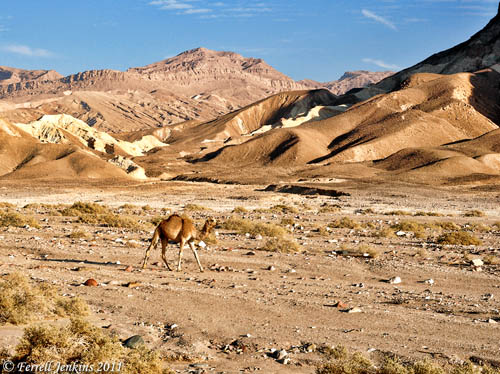
The terrain in the Sinai peninsula is varied. The photo below shows one scene. This photo was made January 25, 2011, the day the Revolution began in Egypt.

A scene in the Sinai Peninsula. Photo by Ferrell Jenkins.

A scene in the Sinai Peninsula. Photo by Ferrell Jenkins.

Monday, March 7, 2011

"Lord..what about.."

"Lord...what about...?"

"Instead you ought to say, "If the Lord wills, we will live and do this or that."
James 4:15


Even if we do not understand what God’s will is, we need to respond to that direction. In fact, when we don’t understand it is even more imperative that we do exactly what he directs us to do in the scriptures. This though can become hard, because it seems repetitive and feels at times like we have to wait forever for an answer. Sometimes, God asks us to make the choice to do his will before we know the specific details of his plan. That’s because part of God’s plan is to develop trust. This is where many of us get into a battle of wills with God, wanting him to reveal his plan to us first and then will we decide whether or not to do what he tells us to do. But this isn't the way it works.

One reason God doesn't give us the full picture of his plans for your life is that you may actually be overwhelmed by what you would see. Peter records, "Concerning this salvation, the prophets who prophesied about the grace that was to be yours searched and inquired carefully..(1 Pet.1:10)." We do not know why it was not revealed to them, but it wasn't. Perhaps it may have been difficult for them to complete what God had in mind, if they had known. Perhaps God simply wanted their faith and trust. But that’s the point—there’s no way you can fulfill what God asks without God empowering us to do so. Even Peter was in a constant battle with Jesus over what to do. Just knowing Jesus what he did of Jesus at the time, the one time that Jesus begins to reveal some of what is about to happen to Him, Peter jumps in and says, "Not so Lord." Satan took occasion of Peter's not knowing and desire to anticipate, to try to stop through Peter what Jesus had just revealed was the will of God! Jesus states then, "But he turned and said to Peter, "Get behind me, Satan! You are a hindrance to me. For you are not setting your mind on the things of God, but on the things of man (Matt 16:23)."

It is a wondrous thing to know without doubt, what God's will is! That is why on some things, we have the Bible - so that we can "the man of God may be competent, equipped for every good work (2 Tim 3:17)." Yet, we must also be content with what God has revealed to us, and learn to leave to the will of God in trust that He knows and is preparing what is best for us those things that have not been made known. On another occasion after the resurrection, Jesus was talking with his chosen apostles, Jesus revealed to Peter a portion of what his future would behold (Jn.21:18). Yet, Peter as impetuous as ever, wants to know what is not meant for him to know - "Lord, what about this man?" Jesus responds to Peter, "If it is my will that he remain until I come, what is that to you? You follow me! (Jn.21:22)"

These then, are the things that we must remember. What is written in God's word, is there for my learning, my faith, and to DO! Outside of this, we must simply revert back to one principle - "YOU FOLLOW ME." Don't worry about what you do not know, don't fret because you do not know where certain things are going to lead you in your life.

Where ever you go, whatever you are doing - FOLLOW the Lord and trust that God will bring about His will in your life in His own way and own time.

Jim

Thursday, March 3, 2011

Bauckham on the Gospels as Histories | Ferrell's Travel Blog

Bauckham on the Gospels as Histories | Ferrell's Travel Blog

Bauckham on the Gospels as Histories

Last Wednesday I went to the Reformed Theological Seminary near Orlando to hear a lecture by Prof. Richard Bauckham. Bauckham was the speaker for the annual Kistemaker Academic Lecture Series. His general topic was The Gospels as Histories: What sort of history are they? I suspect that he was reading chapters that will eventually be published in a new book.

I found Bauckham, Professor Emeritus at St. Andrews University, difficult to understand during the lecture because of the his accent, but I was able to keep up with the general thread of his argument.

If you would like a little taste of Bauckham’s argument about Jesus and the Eyewitnesses I suggest you watch this short video by StJohnsNottingham (other interesting videos also available).

I was delighted to pick up a copy of Jesus and the Eyewitnesses: The Gospels as Eyewitness Testimony at the bookstore and have it autographed by Prof. Bauckham.

Richard Bauckham signs a book. Photo by Ferrell Jenkins.

Richard Bauckham autographs a book. Photo by Ferrell Jenkins.

Order Jesus and the Eyewitnesses from Amazon.
Jesus and the Eyewitnesses: The Gospels As Eyewitness Testimony

Bauckham’s material speaks clearly to the common misconception that the “Church” compiled the Gospels decades, even centuries, after Jesus lived.

Mahanaim — where Jacob wrestled with an angel | Ferrell's Travel Blog

Mahanaim — where Jacob wrestled with an angel | Ferrell's Travel Blog

The name Mahanaim is found 13 times in the Old Testament. The site is where Jacob and Laban met and made a covenant. Mahanaim seems to mean “two camps” (Genesis 32:2). This is where Jacob’s name was changed to Israel after he wrestled with a man (angel, Hosea 12:4). When morning came Israel crossed over Penuel (Genesis 32:31).

Two large tells face each other and the Jabbok River flows in an S-curve between them. The tells are now named Tall adh-Dhahab East and Tall adh-Dhahab West. These tells are located a few miles east of the Plains of the Jordan and Tell Deir Allah (likely the site of biblical Succoth). Some scholars identify Dhahab West as Mahanaim and Dhahab East as Penuel. Other scholars reverse the identifications.

When Transjordan was divided among the tribes, Mahanaim was located in the territory of Gad on the boundary with East Manasseh (Joshua 13:26, 30). It was one of the cities allotted to the Levites (Joshua 21:38; 1 Chronicles 6:80).

After the death of Saul, Abner made Ishbosheth, the son of Saul, king over all Israel from Mahanaim (2 Samuel 2:8, 12, 29).

When David fled from his rebellious son Absalom he fled across the Jordan to Mahanaim (2 Samuel 17:24, 27; cf. 2 Kings 2:8). Absalom met his death in a nearby forest.

A Gileadite by the name of Barzillai took care of King David while he stayed at Mahanaim (2 Samuel 19:32). The city became one of Solomon’s administrative centers (1 Kings 4:14).

Song 6:13 describes gazing upon the Shulammite girl to be like looking on “the dance of the two camps” or “dance of two companies” (CSB, JPS, NAU, NKJ). Other translations use the expression “the dance of Mahanaim” (ASV, NIV, NJPS, TNIV) or “dance of the Mahanaim” (NET).

Recent excavations at Dhahab West, conducted by a German team, have revealed what they believe to be part of a monumental building of Herod the Great. They think this was the Hellenistic and Roman site described by Josephus as Amathus.

Tall adh-Dhahab East (left) and Tall adh-Dhahab West (right). Photo by Ferrell Jenkins.

Tall adh-Dhahab East (left) and Tall adh-Dhahab West (right). These are thought to be the sites of Mahanaim and Penuel. Photo by Ferrell Jenkins.

Our photo shows both tells. (Tall adh-Dhahab East is on the left. Tall adh-Dhahab West is on the right.) There is a pumping station on the Jabbok to provide agricultural irrigation. The Jabbok continues in the valley separating the two hills and tells.

Monday, February 28, 2011

The MADE-UP Jesus

There has arisen a lot of debate in recent years, over what is referred to as the "historical" Jesus and posed by some as being in opposition to the biblical Jesus. The question then becomes, what do we believe? John Dominic Crossan in an article February 27, 2011 states in an overarching message is that you don't have to accept the Jesus of dogma. That there's another Jesus hidden in Scripture and history who has been ignored. Crossnan is a modern reputed scholar and former catholic priest and touted modern "authority" on the "Historical Jesus." So, what do we believe? Who do we believe?

Why is a real relationship with Jesus so difficult? Why is it so challenging? It is because we tend to create a quasi-relationship with a "made-up Jesus." Since the world presents to us a conflicting view of what we see in the gospels, people then tend to create their own version of Jesus in their minds, one who makes few demands on us. This made-up Jesus basically does what we expect, and then leaves us alone. After all, if He's just a historical figure and "an exploited "peasant with an attitude who didn't perform many miracles, physically rise from the dead or die as punishment for humanity's sins ( John Dominic Crossan's 'blasphemous' portrait of Jesus February 27, 2011 By John Blake, CNN)."

Here’s the problem, this made-up Jesus doesn’t care if we succeed or fail, if we’re blind or able to see, if we live or die. We have done what Paul has warned us not to do,
  • "But even if we — or, for that matter, an angel from heaven! — were to announce to you some so-called "Good News" contrary to the Good News we did announce to you, let him be under a curse forever! (Gal.1:8 CJB)"
  • "They have exchanged the truth of God for falsehood, by worshipping and serving created things, rather than the Creator — praised be he for ever. (Rom.1:25)."
There we have it. People such as Crossnan - or the Bible! What is the truth?

Here's the rub! If we accept the view of people like Crossnan, then we have a version of Jesus who makes few or no demands on us. This made-up Jesus basically does what we expect, and then leaves us alone. But, here’s the problem - this made-up Jesus doesn’t care about us. He doesn’t care if we succeed or fail, if we’re blind or able to see, if we live or die. Is that the truth? do you believe that? is that what YOU want to accept?

Jesus says in Revelation 3:20, “Here I am! I stand at the door and knock. If anyone hears my voice and opens the door, I will come in and eat with him, and he with me” (NIV). That doesn't sound like someone who doesn't care to me. It sounds to me like the real Jesus cares deeply about us. That He loves us passionately and has been pursuing us since the day we were born. The Jesus of the Bible, doesn’t want a relationship of rote prayers, rule keeping and formulas. Paul wrote, "that according to the riches of his glory he may grant you to be strengthened with power through his Spirit in your inner being, so that Christ may dwell in your hearts through faith--that you, being rooted and grounded in love, may have strength to comprehend with all the saints what is the breadth and length and height and depth, and to know the love of Christ that surpasses knowledge, that you may be filled with all the fullness of God.(Eph.3:16-19)."

This is a rich and deep and ultimately fulfilling relationship. Sometimes, it will be messy, uncomfortable, and a passionate relationship. That’s why the Jesus of the Bible won’t leave you alone, because He wants you to experience real and eternal life. This is a real relationship with the real Jesus who hung on a cross for you. Picture him there, looking across through time and into your eyes saying, “I love you. I’m willing to die for you. I’m willing to give everything so that you can know me and have a real life of passion, love and eternal life.”

You can ignore him; you can curse him; you can refuse to believe He exists. But regardless of what you think or what you choose to believe, there is a fact that remains true throughout time. "The Lord is not slow to fulfill his promise as some count slowness, but is patient toward you, not wishing that any should perish, but that all should reach repentance. (2 Pet.3:9)."

Where are you at? Are you content to live the life that you’ve lived? Are you content to continue deluding yourself that Jesus isn't real, doesn't' care, or that he's just some historical being that was a peasant with an attitude? Or are you ready to cross that line to live a passionate and real relationship with a real Jesus who loves you?

"The Spirit and the bride say, "Come!"
Everyone who hears this should say, "Come!"
If you are thirsty, come! If you want life-giving water, come and take it. It's free!"
Rev.22:17

Jim