Search This Blog

Sunday, December 19, 2010

Is there life after death? - Zoecity

Is there life after death? - Zoecity

Is there life after death?

Source: www.gotquestions.org


The existence of life after death is a universal question. Job speaks for all of us by stating, "Man born of woman is of few days and full of trouble. He springs up like a flower and withers away; like a fleeting shadow, he does not endure....If a man dies, will he live again?" (Job 14:1-2, 14). Like Job, all of us have been challenged by this question. Exactly what happens to us after we die? Do we simply cease to exist? Is life a revolving door of departing and returning to earth in order to eventually achieve personal greatness? Does everyone go to the same place, or do we go to different places? Is there really a heaven and hell?

The Bible tells us that there is not only life after death, but eternal life so glorious that "no eye has seen, no ear has heard, and no mind has imagined what God has prepared for those who love him" (1 Corinthians 2:9). Jesus Christ, God in the flesh, came to the earth to give us this gift of eternal life. "But he was pierced for our transgressions, he was crushed for our iniquities; the punishment that brought us peace was upon him, and by his wounds we are healed" (Isaiah 53:5). Jesus took on the punishment that all of us deserve and sacrificed His life to pay the penalty for our sin. Three days later, He proved Himself victorious over death by rising from the grave. He remained on the earth for forty days and was witnessed by thousands before ascending to heaven. Romans 4:25 says, "He was delivered over to death for our sins and was raised to life for our justification."

The resurrection of the Christ is a well-documented event. The apostle Paul challenged people to question eyewitnesses for its validity, and no one was able to contest its truth. The resurrection is the cornerstone of the Christian faith. Because Christ was raised from the dead, we can have faith that we, too, will be resurrected. The resurrection of Jesus Christ is the ultimate proof of life after death. Christ was only the first of a great harvest of those who will be raised to life again. Physical death came through one man, Adam, to whom we are all related. But all who have been adopted into God's family through faith in Jesus Christ will be given new life (1 Corinthians 15:20-22). Just as God raised up Jesus' body, so will our bodies be resurrected upon Jesus' return (1 Corinthians 6:14).

Although we will all be eventually resurrected, not everyone will go to heaven. A choice must be made by each person in this life, and this choice will determine one's eternal destination. The Bible says that it is appointed for us to die only once, and after that will come judgment (Hebrews 9:27). Those who have been made righteous by faith in Christ will go into eternal life in heaven, but those who reject Christ as Savior will be sent to eternal punishment in hell (Matthew 25:46). Hell, like heaven, is not simply a state of existence, but a literal place. It is a place where the unrighteous will experience never-ending, eternal wrath from God. Hell is described as a bottomless pit (Luke 8:31; Revelation 9:1) and a lake of fire, burning with sulfur, where the inhabitants will be tormented day and night forever and ever (Revelation 20:10). In hell, there will be weeping and gnashing of teeth, indicating intense grief and anger (Matthew 13:42).

God takes no pleasure in the death of the wicked, but desires them to turn from their wicked ways so that they can live (Ezekiel 33:11). But He will not force us into submission; if we choose to reject Him, He accepts our decision to live eternally apart from Him. Life on earth is a test, a preparation for what is to come. For believers, life after death is eternal life in heaven with God. For unbelievers, life after death is eternity in the lake of fire. How can we receive eternal life after death and avoid an eternity in the lake of fire? There is only one way"through faith and trust in Jesus Christ. Jesus said, "I am the resurrection and the life. He who believes in me will live, even though he dies; and whoever lives and believes in me will never die..." (John 11:25-26).

The free gift of eternal life is available to all. "Whoever believes in the Son has eternal life, but whoever rejects the Son will not see life, for God's wrath remains on him" (John 3:36). We will not be given the opportunity to accept God's gift of salvation after death. Our eternal destination is determined in our earthly lifetimes by our reception or rejection of Jesus Christ. "I tell you, now is the time of God's favor, now is the day of salvation" (2 Corinthians 6:2). If we trust the death of Jesus Christ as the full payment for our sin against God, we are guaranteed not only a meaningful life on earth, but also eternal life after death, in the glorious presence of Christ.

Monday, December 13, 2010

Vessels of honor and dishonor | Ferrell's Travel Blog

Vessels of honor and dishonor | Ferrell's Travel Blog

Vessels of honor and dishonor

In explaining to Timothy the importance of right living, Paul says,

Now in a great house there are not only vessels of gold and silver but also of wood and clay, some for honorable use, some for dishonorable. Therefore, if anyone cleanses himself from what is dishonorable, he will be a vessel for honorable use, set apart as holy, useful to the master of the house, ready for every good work. (2 Timothy 2:20-21 ESV)

The term vessel (Greek, skeuos) is used of literal vessels made of clay, gold, silver, or wood. It is also used by analogy of individuals as a vessel. I have chosen two photos to illustrate vessels of different value. The first shows vessels from Middle Bronze II Jericho made of clay. Vessels of this type were used throughout Bible times.

Middle Bronze II pottery from Jericho. Vatican Museum. Photo by Ferrell Jenkins.

Middle Bronze II pottery from Jericho. Vatican Museum. Photo by Ferrell Jenkins.

The next photo shows several pieces of “mold-blown perfume vessels decorated with stylized motifs” on display at the Eretz Israel Museum, Tel Aviv, Israel. These vessels are obviously more delicate and require more care than the ordinary clay vessels. For our time we might compare Melmac (if you are too young to know, look it up!) and fine china.

Mold-blown perfume vessels. Erezt Israel Museum. Photo by Ferrell Jenkins.

Mold-blown perfume vessels. Erezt Israel Museum. Photo by Ferrell Jenkins.

Paul says to Timothy, and to us, “be a vessel for honorable use, set apart as holy, useful to the master of the house.”

Peter uses a similar analogy in speaking of the husband’s responsibility to his wife.

Likewise, husbands, live with your wives in an understanding way, showing honor to the woman as the weaker vessel, since they are heirs with you of the grace of life, so that your prayers may not be hindered. (1 Peter 3:7 ESV)

Scholar claims evidence for Toi king of Hamath | Ferrell's Travel Blog

Scholar claims evidence for Toi king of Hamath | Ferrell's Travel Blog

Scholar claims evidence for Toi king of Hamath

King Toi of Hamath is mentioned in two Biblical texts.

Now when Toi king of Hamath heard that David had defeated all the army of Hadadezer, Toi sent Joram his son to King David to greet him and bless him, because he had fought against Hadadezer and defeated him; for Hadadezer had been at war with Toi. And Joram brought with him articles of silver, of gold and of bronze. (2 Samuel 8:9-10 NAU)

See also 1 Chronicles 18:9-10 where he is mentioned under the name Tou.

Prof. Aren Maeir reports on his Gath blog that Prof. Itamar Singer called his attention to an article by “C. Steitler (“The Biblical King Toi of Hamath and the Late Hittite State of ‘P/Walas(a)tin’”. Biblische Notizen 146 [2010]: 81-99) in which the author claims that one can identify the recently identified King Tatais, king of P/Walas(a)tin (from new inscriptions in Syria), with Toi, king of Hamath, mentioned in II Sam 8, 9-10; I Chr 18, 9-10.”

Maeir gives this brief summary of the article:

“David’s alliance with Toi, king of Hamath (2Sam 8,9-10) can be anchored in the historical context of Syria. Recent archaeological and philological studies have demonstrated the continuity between the Hittite Great Empire and the late Hittite kingdom, P/Walas(a)tin, to which Hamath belonged. Based on historical and onomastic analyses, the biblical Toi should be identified with a king of P/Walas(a)tin, Taitas.”

Take a look at Prof. Maeir’s observations here. This will be a great story to follow.

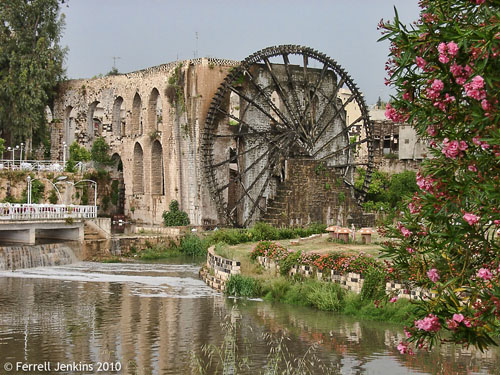
Hamath is associated with the modern city of Hama on the Orontes River in Syria. The city is noted for its norias. These waterwheels were used for several centuries to divert water from the river for agricultural purposes. Today those that remain are mostly decorative.

One of the Norias on the Orontes River at Hama, Syria. Photo by Ferrell Jenkins.

One of the norias on the Orontes River at Hama, Syria. Photo by Ferrell Jenkins.


Maintaining an Evangelistic Focus in Groups and Sunday School Classes | Dr. Mark Miller Blog

Maintaining an Evangelistic Focus in Groups and Sunday School Classes | Dr. Mark Miller Blog

Maintaining an Evangelistic Focus in Groups and Sunday School Classes

While working on my doctorate in 2005, I took a seminar in conjunction with Willow Creek’s Small Group conference. One interesting revelation surfaced during an interview with Rex Minor, the Executive Director for Willow Creek Community Church at that time. As a result of focus groups that the church conducted, evangelism was identified as the weakest aspect of most Willow small groups. Sunday School has been called the outreach arm of Southern Baptist churches. The truth is that evangelism is the weakest aspect of most Sunday School classes.

A vision to fulfill the Great Commission is imperative for small groups or Sunday School classes:

The Sunday School must be plugged into a passion for evangelism; otherwise, it will settle into the comfort zone of a maintenance organization. By ignoring the evangelistic potential of the Sunday School, we have reduced Sunday School to a stagnant pool of introverted groups that look primarily to their own needs and interests and ignore the plight of the unsaved.

Why do some Sunday school classes fail? Why do some small groups fail? They fail when group members turn inward and begin to function for their own welfare. Unprepared teachers, members who talk about “my class, my room, my teacher, my friends, my, my, my,” and an ineffective organization keep churches from reaching the “fields that are white unto harvest.”

It is imperative that Sunday School and Small Groups keep the main thing, the main thing.

Wednesday, December 1, 2010

Do You Have Mercy Amnesia? - Zoecity

Do You Have Mercy Amnesia? - Zoecity

Do You Have Mercy Amnesia?

By Shaun King
This week's topic: The Mercy Of God

The more you remember that YOU NEED MERCY, the easier it is to freely GIVE IT OUT. I can smell a person with mercy amnesia from a mile away. They are judgmental. They spread gossip. They count people out. Having lost touch with how much God has forgiven them, they basically have to live a lie by pretending like they have it all together.

The problem is the more religious most of us get, the more we “go to church,” the more we listen to Christian radio, the more pastors we follow on Twitter – the less we remember how broken we’ve been and still are today.

This is dangerous!

It’s dangerous because the second we lose touch with how much we still need the new mercies of our God we begin to subconsciously pretend like we made it here all by ourselves. But you and I know that you aren’t smart enough, cute enough, wealthy enough, savvy enough, articulate enough, or connected enough to get where you are today or where you want to be tomorrow!

How many sins have you committed over the course of your life? You can’t even remember every sin you’ve committed. Let’s be real – it would take a scientific calculator to multiply out your sin per year ratio! How many times have you asked or even begged God for forgiveness? How many times have you found yourself in a bind in which you knew ONLY GOD could get you out? We’re talking about some pretty big numbers right?

Listen, I want you to have a healthy self-esteem. I want YOU to feel good about YOU, but if feeling good about YOU requires you to forget how much you need God…something’s wrong! I’ve won awards and earned degrees. I’ve been on TV and all over the internet, but the bulk of my confidence comes not from myself, but from the fact that the same God that mercifully forgave Peter for denying him three times and then empowered him to lead the first movement of revolutionary Christians is the same God that forgives and empowers me today!

When you live with the mercy of God on your mind (and on your lips) here are at least 2 great things that happen:

1. You bring new people to the faith! By revealing your brokenness and reliance upon the mercy of God, you will gain trust even with strangers. Our contrived togetherness causes broken people to wonder what’s wrong with them instead of what’s right about our God.

2. You stay fresh! Your faith starts dying when you stop living like you need God. It’s great that you have a testimony of what God did for you in 1988, but people will want to know how God has been real for you in 2010. Trust me – a fresh faith rooted in the mercy of God can take you places.

Scripture Of The Day: "For by grace you have been saved through faith. And this is not your own doing; it is the gift of God, not a result of works, so that no one may boast." - Ephesians 2:8-9

Tuesday, November 30, 2010

Crown suggests Queen Arsinoë II ruled ancient Egypt as female pharaoh

Crown suggests Queen Arsinoë II ruled ancient Egypt as female pharaoh

Crown Suggests Queen Arsinoë II Ruled Ancient Egypt as Female Pharaoh

ScienceDaily (Nov. 29, 2010) — A unique queen's crown with ancient symbols combined with a new method of studying status in Egyptian reliefs forms the basis for a re-interpretation of historical developments in Egypt in the period following the death of Alexander the Great. A thesis from the University of Gothenburg (Sweden) argues that Queen Arsinoë II ruled ancient Egypt as a female pharaoh, predating Cleopatra by 200 years.

Researchers are largely agreed on Queen Arsinoë II's importance from the day that she was deified. She was put on a level with the ancient goddesses Isis and Hathor, and was still respected and honoured 200 years after her death when her better-known descendant Cleopatra wore the same crown. But the reasons behind Arsinoë's huge influence have been interpreted in many different ways.

Maria Nilsson has studied her historical importance by interpreting her personal crown and its ancient symbols. The crown, which has never been found but is depicted on statues and Egyptian reliefs, was created with the help of the powerful Egyptian priesthood to symbolise the qualities of the queen. The thesis questions the traditional royal line which excludes female regents, and defies some researchers' attempts to minimise Arsinoë's importance while she was still alive.

"My conclusion instead is that Arsinoë was a female pharaoh and high priestess who was equal to and ruled jointly with her brother and husband, and that she was deified during her actual lifetime," says Nilsson. "It was this combination of religion and politics that was behind her long-lived influence."

But it was not only Cleopatra who wanted to re-use Arsinoë's important and symbolic crown. Male descendants -- all named Ptolemy -- used her crown as a template when creating a new crown which they gave to the goddess Hathor to honour the domestic priesthood and so win its support when Egypt was gripped by civil war.

The thesis is clearly structured around the crown and includes its wider context in the reliefs. Nilsson paints an all-round picture of the queen, how she dressed, the gods she was depicted with, the titles she was given, and so on.

The source material comes from Egypt and can be used as a basis for understanding the country's political and religious development. At the same time, Nilsson paves the way for future studies of Egyptian crowns as symbols of power and status, and of the development of art in a more general sense.

"The creation of Queen Arsinoë's crown was just the beginning," she says.

Monday, November 29, 2010

Where did Peter preach on Pentecost? | Ferrell's Travel Blog

Where did Peter preach on Pentecost? | Ferrell's Travel Blog

A questions comes from a young friend who has traveled to Israel with me, and who is preparing a sermon related to Peter’s sermon on Pentecost (Acts 2). He asks,

Where do you think that Peter spoke from on Pentecost? I ask because I plan on using pictures and visuals in PowerPoint and I want to make sure I’m showing pictures of the right places. From my research, it seems most likely that Peter would have either spoken from the southern steps leading up to the Temple Mount (the double gate) or from the actual Temple Mount. I plan to show just how large the area was, and why there would have been so many people at the Temple that day and at that time (9:00 am).

I have gathered a few comments that express some of my thoughts on this matter.

Some scholars begin with the “one place” where the disciples were gathered (Acts 2:1). It is said to be a “house” (Greek, oikos, Acts 2:2). Kistemaker indicates the place was a house and not in the precincts of the temple. He says we can not be certain, but assumes it was a place near the temple.

Where were the believers? Luke tersely writes that they were “in one place.” If we think of the upper room (1:13), we question whether this room could accommodate a group of 120. Luke, however, indicates that they were sitting in a house (v. 2) and not in the precincts of the temple.3 We admit that we are unable to achieve certainty, but we presume that the meeting place was near the temple, where the apostles stayed continually praising God (compare Luke 24:53). — New Testament Commentary: Exposition of the Acts of the Aposltes, 76.

Longnecker discusses references where the term house is used of the temple. He says,

… in the temple precincts they would have had the best opportunity of addressing a large crowd.

His conclusion is,

Therefore it is likely that Luke meant us to picture that same upper room as the setting for the miracle of the Spirit’s coming and the place from where the disciples first went out to proclaim the gospel.

The view that the preaching of Acts 2 took places in the house (upper room) does not provide suitable explanation for the larger group suggested in the text. About three thousand persons accepted the gospel and were baptized on that day (Acts 2:41). There were obviously many who did not obey.

Acts 2 begins in a house, but closes in the temple (Acts 2:46). Marshall expresses my thoughts.

We must assume that at some point the disciples moved outside from the upper room and came in contact with the crowds assembled in Jerusalem for the feast; dwelling need not necessarily imply permanent residence, although many Jews did return to Jerusalem from the Dispersion to end their days there. (Acts: An Introduction and Commentary, Tyndale New Testament Commentaries)

We should note that the term for temple in Acts 2 is hieros. This is the term used of the “temple courts” (NET) or the “temple complex” (CSB).

Second Temple model at the Israel Museum. Photo by Ferrell Jenkins.

Second Temple model at the Israel Museum. Photo by Ferrell Jenkins.

The temple precinct or complex is large. I was in Jerusalem one year at the close of the Moslem Ramadan when it was reported that more than 100,000 persons were present in the area. This would have provided adequate space for the activities of Acts 2.

The LORD prophesied through Isaiah about the events of the Pentecost of Acts 2.

And many peoples will come and say, “Come, let us go up to the mountain of the LORD, To the house of the God of Jacob; That He may teach us concerning His ways And that we may walk in His paths.” For the law will go forth from Zion And the word of the LORD from Jerusalem. (Isaiah 2:3 NAU)

It is true that the term Zion was sometimes applied to the entire city of Jerusalem, but it frequently seems to have a more specific reference to the temple area.

The disciples continued to go up to the temple at the hour of prayer (Acts 3:1). Their number soon grew to five thousand men and they met in Solomon’s Portico, thought to be on the east side of the temple platform (Acts 4:4; 5:12).

Where did Peter preach? I can’t be absolutely certain, but I opt for the temple complex. A copy of the photo suitable for presentations is available by clicking on the image.