Search This Blog

Wednesday, March 7, 2012

Thinking you’re naked. | Stuff Christians Like – Jon Acuff

Thinking you’re naked. | Stuff Christians Like – Jon Acuff:

'via Blog this'


Thinking you’re naked.

I don’t want to brag, but I’m pretty awesome at applying band-aids. And make no mistake, that is an art. Because if you go too quickly and unpeel them the wrong way, they stick to themselves and you end up with a wadded up useless mess, instead of the Little Mermaid festooned bandage your daughter so desperately wants to apply to a boo boo that may in fact be 100% fictional.
Half of the injuries I treat at the Acuff house are invisible or simply wounds of sympathy. My oldest daughter will scrape her knee, and my 3-year old, realizing the band aid box is open will say, “Yo dad, I’d like to get in on that too. What do you say we put one on, I don’t know, my ankle. Yeah, my ankle, let’s pretend that’s hurt.”
But sometimes the cuts are real, like the day my 5-year old got a scrape on her face playing in the front yard. I rushed in the house and returned with a princess bandage. As I bent down to apply it to her forehead, her eyes filled up with tears and she shrunk back from me.
“What’s wrong?” I asked.
“I don’t want to wear that band-aid.” She replied.
“Why? You have a cut. You need a band-aid.” I said.
“I’ll look silly,” she answered.
Other than her sister and her mom, there was no one else in the yard. None of her friends were over, cars were not streaming by our house and watching us play, the world was pretty empty at that moment. But, for the first time I can remember, she felt shame. She had discovered shame. Somewhere, somehow, this little 5-year-old had learned to be afraid of looking silly. If I was smarter, if I had been better prepared for the transition from little toddler to little girl, I might have asked her this:
“Who told you that you were silly?”
I didn’t, though. That question didn’t bloom in my head until much later, and I didn’t understand it until I saw God ask a similar question in Genesis 3:11. To me, this is one of the saddest and most profoundly beautiful verses in the entire Bible. Adam and Eve have fallen. The apple is a core. The snake has spoken. The dream appears crushed. As they hide from God under clothes they’ve hastily sewn together, He appears and asks them a simple question:
“Who told you that you were naked?”
There is hurt in God’s voice as He asks this question, but there is also a deep sadness, the sense of a father holding a daughter that has for the first time ever, wrapped herself in shame.
Who told you that you were not enough?
Who told you that I didn’t love you?
Who told you that there was something outside of me you needed?
Who told you that you were ugly?
Who told you that your dream was foolish?
Who told you that you would never have a child?
Who told you that you would never be a father?
Who told you that you weren’t a good mother?
Who told you that without a job you aren’t worth anything?
Who told you that you’ll never know love again?
Who told you that this was all there is?
Who told you that you were naked?
I don’t know when you discovered shame. I don’t know when you discovered that there were people who might think you are silly or dumb or not a good writer or a husband or a friend. I don’t know what lies you’ve been told by other people or maybe even by yourself.
But in response to what you are hearing from everyone else, God is still asking the question, “Who told you that you were naked?”
And He’s still asking us that question because we are not.
In Christ, we are not worthless.
In Christ, we are not hopeless.
In Christ, we are not dumb or ugly or forgotten.
In Christ, we are not naked.
Isaiah 61:10 says:
“For he has clothed me with garments of salvation and arrayed me in a robe of righteousness.”
The world may try to tell you a thousand different things today. You might close this post and hear a million declarations of who you are or who you’ll always be, but know this:
As unbelievable as it sounds, and as much as I never expected to type this sentence on this blog:
You are not naked.

Monday, March 5, 2012

WARNING! - Its PERSONAL!


Do not do this only while being watched in order to please them, but be like slaves of Christ who do God's will from the heart.
                                                                                                                                        Eph 6:6  


The Bible is a living entity (1 Pet.1:23) that is able to change your life. It reflects what you truly are (Jas.1:23) and is able to cut to the true heart of matters in your innermost thoughts and attitudes (Heb.4:12). However, the scripture will not become a dynamic thing to you until you allow it to become personal and specific. We use the Bible often in an offensive way, to attack the thoughts and views of others to "correct them from the error of their way."  Yet, do we realize that the Bible is not written to THEM...it is written to US personally!

"Yeah - right!" someone might say. But, have you ever tried to read the scripture by personalizing it? Simply put your name in the place of pronouns or nouns in Scripture. For example, if you were to personalize James 1:23,24, you would write or say "For if ____(your name here)  is a hearer of the word and not a doer, __________(your name here) is like a man who looks intently at his natural face in a mirror. For ________(your name here) looks at himself and goes away and at once forgets what __________(your name here) was like."

Let's personalize another one!  Philippians 1:6: “He who began a good work in _____(your name here) will carry it on to completion until the day of Christ Jesus.”

This method is a great means to strengthen your faith and encourage yourself. However, be warned that if you do, it will begin to change you. Many passages of Scripture might  literally bring tears to your eyes. The Bible will become God’s letter to you. It will become God’s gift to you! 

Reading your Bible is not just about getting to know the content of the Word, or the technicalities of the law so that I can appear educated and show someone else up. The Bible was give to us so that we could get to know the author of the Word — personally!

So...here are some thoughts for you to consider today.
  • Have you ever thought about the Bible as a letter to you personally?
  • Do you treat the Bible and your quiet time with God as a personal conversation between you and God?

Jim

Saturday, March 3, 2012

BiblePlaces Blog: Talpiot Tomb Updates

BiblePlaces Blog: Talpiot Tomb Updates:

'via Blog this'

Wednesday, February 29, 2012

Talpiot Tomb Updates

The official website for “The Jesus Discovery” is now up. And down (bandwidth limit exceeded). An interview with the authors is here, when the site is back up.

The Jesus Discovery book by James Tabor has skyrocketed to #1 in all of its categories at Amazon and an overall rank of #174.

More than a dozen photos from the press conference are online. (HT: Joseph Lauer). Apparently James Charlesworth, lead academic consultant to the team, skipped the show.

In a comment on Eric Meyers’ post, Tabor advances the view that Jesus’ body was first buried at the Holy Sepulcher site and then moved to the Talpiot tomb.

Robert Cargill suggests that the “fish” is a tomb nephesh and he claims (in the comments) that two photos supplied by the authors have been doctored or of different “fish.” (I’m not convinced.)

Antonio Lombatti provides an image of another fish inscribed on an ossuary.

James Tabor confirms Gordon Franz’s observation that everyone has the fish turned the wrong way. If so, why were all of the photos released as horizontal shots?

Jodi Magness is chagrined to see archaeology “hijacked in the service of non-scientific interests.” In a comment, Tabor disagrees that such is the case and he writes of the fish etching that “at least half a dozen art historians have agreed with the Jonah interpretation.” Stephen Goranson notes that none of them have been quoted and he wonders if “signed non-disclosure agreements help scholarship.”

Michael Heiser explains why the process of using the “clueless archaeo-media” is rejected by scholars as a pursuit for cash and not for accuracy. “It’s the methodological equivalent to using mainstream media connections to announce a cure for cancer without clinical trials, or presenting one’s off-the-radar conspiratorial theory (the academic word would be avant garde) about Zionism instead of getting critical feedback from field experts first. But that’s boring and doesn’t generate sales.”

James Davila is pleased with the scholarly response to the announcement and that the media appears to be heeding it (unlike in times past).

Summaries of responses are also provided by Tom Verenna, Mark Goodacre and Stephen Smuts.

Has the tomb of a pre-70 A.D. Christian been found? | Ferrell's Travel Blog

Has the tomb of a pre-70 A.D. Christian been found? | Ferrell's Travel Blog:

'via Blog this'

Has the tomb of a pre-70 A.D. Christian been found?

It happens either before Christmas or Easter. A tremendous discovery has been made that will support or undermine Christianity. Everything we have always thought about Jesus, the early Christians, and the Bible will undergo a radical change as soon as the book by the discoverers and the TV program is released. (I have some friends who think so literally that I am fearful they will not understand my attempt to be satirical.)

James Tabor at SBL, Atlanta, 2010.

Prof. James Tabor at SBL, 2010.

If I say nothing about this, some readers will send me links to it and ask my opinion. Rather than dig into all of this material about the discovery by Prof. James Tabor and filmmaker Simcha Jacobovici, I am going to direct my readers to Todd Bolen’s Bible Places Blog. Todd will do a much better job with this than I could. You might prefer to begin with the bottom link and move up. Then check for updates for the next few days.

Bolen has already posted three significant blogs ahead of the onslaught of media attention. Read, and examine carefully.

  • More Reports on the Jerusalem Fish Ossuary here.
  • Jesus Discovery: Early Christian Burial in Jerusalem here.
  • Tomorrow: The Jesus Discovery here.

The words of an early Christian apostle would be appropriate here.

But examine all things; hold fast to what is good. (1 Thessalonians 5:21 NET)

UPDATE: Todd Bolen has now commented on Dr. Tabor’s preliminary reporthere. The complete 46-page report is available in PDF here.

Let the media begin. Fox News just ran a report about this discovery. See link here. Trace Gallagher informed us that “the gospels date to 200 or 300 years after Jesus.” Poor guy. I think he means well, but has left his area of expertise.

UPDATE Feb. 29: Bible Places Blog includes a report here by Gordon Franz who was present at the press conference. Franz says,

My initial impression is that the “fish” looks like an ornamental glass vessel, perhaps a pitcher or flask of some sort.

An illustration is included.

The Jerusalem Syndrome | Ferrell's Travel Blog

The Jerusalem Syndrome | Ferrell's Travel Blog:

'via Blog this'

The Jerusalem Syndrome

Each year about 50 visitors to Jerusalem have to be taken to a psychiatric ward because they are overcome with what they experience in the Holy City. In the worst cases individuals have come to believe that they are the Messiah, or that they are preparing the way for Him. Psychiatrists call this phenomenon the “Jerusalem Syndrome.”

I have no idea who the fellow below thinks he is imitating, but I have dubbed him an “actor” — not someone who has been overcome with the Jerusalem Syndrome. Some might say that he is “John the Baptist, others say Elijah, and others Jeremiah or one of the prophets.” (Matthew 16:14 ESV)

An "actor" on the Mount of Olives. Photo by Ferrell Jenkins.

An "actor" on the Mount of Olives poses as a biblical character. Photo: Ferrell Jenkins.

Wired Magazine recently ran a fascinating article by Chris Nashawaty dealing with the Jerusalem Syndrome. He interviews Dr. Pesach Lichtenberg, head of the men’s division of psychiatry at Herzog Hospital in Jerusalem. Lichtenberg and Nashawaty visit the Old City of Jerusalem in search of a likely prospect for Jerusalem Syndrome. Read the article in its entirety here.

I had been unaware that visitors to Florence, Italy, experience a similar phenomenon when they “are overwhelmed by powerful works of art.” There, it is called Stendhal syndrome after the writer who described it in the early 19th century. Japanese tourists are especially subject to Paris syndrome while visiting the City of Light.

The sights of Jerusalem are truly impressive, and some tourists who tend to be emotional are often brought to tears by what they see and hear.

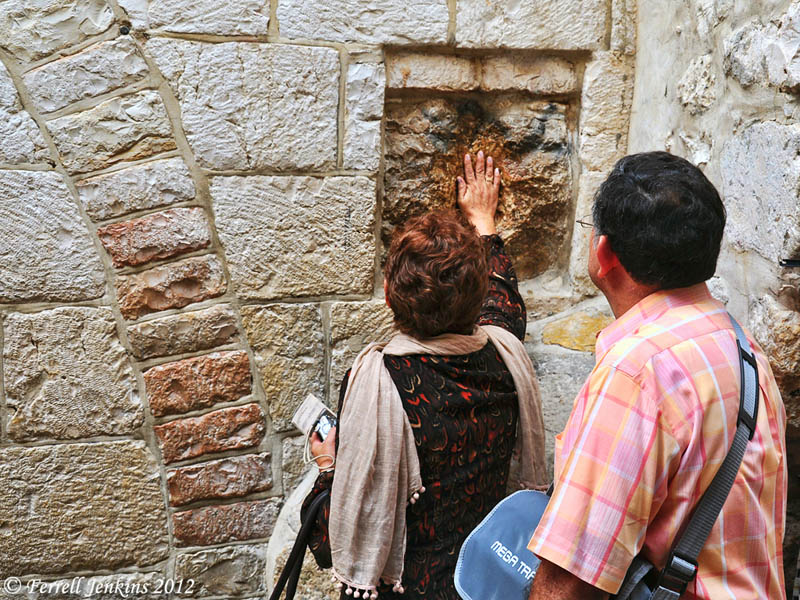
A woman places her hand on a stone at the fifth station of the cross. Photo by Ferrell Jenkins.

A woman places her hand on a stone at the fifth station of the cross. Some say this is a stone touched by Jesus on His way to the crucifixion. Photo by Ferrell Jenkins.

It is not every day that you see someone like this selling jewelery and souvenirs.

Vendor in the Jewish Quarter of Jerusalem. Photo by Ferrell Jenkins.

Vendor in the Jewish Quarter of Jerusalem. Photo by Ferrell Jenkins.

We ran a brief note about the Jerusalem Syndrome about four years ago here.

HT: Either Jack Sasson or Joseph Lauer (perhaps both), but I have misplaced the Email.

Thursday, March 1, 2012

Ancient Gravestone Epitaphs Give Insight into Early Jews and Christians – Bible History Daily

Ancient Gravestone Epitaphs Give Insight into Early Jews and Christians – Bible History Daily:

'via Blog this'

Ancient Gravestone Epitaphs Give Insight into Early Jews and Christians

Understanding Christian and Jewish tombstones from ancient Zoora

Ancient Gravestone Epitaphs Give Insight into Early Jews and Christians

Most Jewish tombstones from Zoar (Zoora) carry Aramaic inscriptions painted in red ochre (see above). These gravestone epitaphs give the name of the deceased, followed by the date of death and conclude with expressions of peace.

Amid the desolate, rocky wasteland of Biblical Zoar (ancient Zoora) along the southeastern shore of the Dead Sea, Konstantinos Politis and others have discovered hundreds of remarkable tombstones that preserve detailed portraits of life—and death—among the Christians and Jews who once dwelled there (see also “Ancient World’s Largest Cemetery Identified at Biblical Zoar”). The often brightly colored and intricately decorated stones are a treasure trove of information about these two communities during the fourth to sixth centuries C.E. when Zoar (then known as Zoara or Zoora) was the seat of a major Christian bishopric and also home to a significant Jewish population.

In “Tales from Tombstones” in the March/April 2012 issue ofBiblical Archaeology Review, two scholars expert in interpreting the gravestone epitaphs and iconography—Professor Steven Fine and Kalliope I. Kritikakou-Nikolaropoulou—provide separate discussions of the Christian and Jewish tombstones of Zoora.

According to Fine, the Jewish tombstones from Zoora typically feature Jewish Aramaic inscriptions painted in red ochre surrounded by a decorative border. The gravestone epitaphs give the name of the deceased, followed by the day, month and year of death and then conclude with expressions of peace unto Israel. The painted texts of the Jewish tombstones are often accompanied by stylized depictions of common Jewish symbols, such as the seven-branched menorah.


Ancient Gravestone Epitaphs Give Insight into Early Jews and Christians

This Christian tombstone, colorfully decorated with deeply carved, green-and-red-painted symbols, belonged to Gorgonios, son of Claudius, a 55-year-old subdeacon of Zoora.

In addition, the Jewish tombstones provide important insight into the makeup of the Jewish community of Byzantine Zoora. From the gravestone epitaphs, we learn that Zoora had rabbis, priests and Levites, and that most Jews had common Biblical names like Jacob, Saul and Esther. Likewise, we learn that date of death on Jewish tombstones was most often reckoned by the number of years since the Roman destruction of the Temple (70 C.E.).

As discussed by Kritikakou-Nikolaropoulou, more than 400 Christian tombstones have been discovered in Zoora, almost all of which are inscribed in Greek. The gravestone epitaphs of the Christians of Zoora typically include several lines of incised text that give the name of the deceased, their age, followed by the exact date of death. The majority of the tombstones are colorfully decorated with common Christian symbols, such as the cross, birds, fish and palm branches.

As with the Jewish tombstones, the gravestone epitaphs reveal much about the Christian community of Zoora. In addition to providing the names of local Christians, the gravestone epitaphs furnish a nearly complete list of local church officials, from deacons and subdeacons to presbyters and bishops. Similarly, we find the year of death reckoned according to the number of years since Trajan’s establishment of the province of Arabia (106 C.E.).