Search This Blog

Sunday, November 20, 2011

BiblePlaces Blog: Weekend Roundup

BiblePlaces Blog: Weekend Roundup:

'via Blog this'

Sunday, November 20, 2011

Weekend Roundup

Luke Chandler has responded to some of my questions about the recently announced cultic room at Khirbet Qeiyafa. I’m still curious if anyone else is convinced that Garfinkel has found one cultic room, let alone three. (Or, did pillars ever support roofs or were they only used for worship?)

The results from the first two seasons of excavation at Tel Burna(Libnah?) were presented at the ASOR meeting yesterday and the PowerPoint presentation is now available for download.

Haaretz reports on the development of the Abraham Path, a route intended to run from Haran in Turkey south to the patriarch’s burial place in Hebron.

Wayne Stiles introduces readers to the first-century boat found on the shore of the Sea of Galilee. The Jerusalem Post article includes 7 photos.

In his weekly column, Joe Yudin gives the historical basis for locatingthe Pools of Bethesda next to the Church of St. Anne.

The reason that the Jordan River today is a pathetic stream composed largely of sewage is that “97% of its historical flow of some 1,250 million cubic meters per year has been diverted by Israel, Syria and Jordan,” according to a report described in the Jerusalem Post.

The AP reports on the progress being made in mapping every tombstone on the Mount of Olives.

Another former church in Turkey, this one famous for hosting the Second Council of Nicaea, has been turned into a mosque.

Thursday, November 17, 2011

The Patriarchs lived in the Negev | Ferrell's Travel Blog

The Patriarchs lived in the Negev | Ferrell's Travel Blog:

'via Blog this'

The Patriarchs lived in the Negev

English Bibles translate the Hebrew word negev in a variety of ways.

  • South — KJV; NKJV
  • “the South [country]” is the Translator’s Note in the NET Bible. A study note says, “Negev is the name for the southern desert region in the land of Canaan.”
  • Negeb — ESV
  • Negev — most modern English versions.
  • eremos — the word for desert or wilderness is used in the LXX. This word does not describe the Negev precisely enough.

I am away from home and most of my resources, but I recall hearing the late Anson Rainey describe the Negev like the figure 8. Turn the 8 horizontal with Beersheba in the center. The area is one that is often subject to drought and famine.

The Patriarchs, Abraham, Isaac, and Jacob spent much time in the Negev (Genesis 12:9; 13:1,3; 20:1; 24:62).

The Israelite spies were sent by Moses from the Sinai to investigate Canaan. The text makes it clear that they had to go through the Negev to get to the hill country and Hebron. Hebron is only about 25 miles north of Beersheba. Once we head south from Hebron we begin to notice a change from the hill country to a more dry clime.

When Moses sent them to investigate the land of Canaan, he told them, “Go up through the Negev, and then go up into the hill country (Numbers 13:17 NET)

When they went up through the Negev, they came to Hebron… (Numbers 13:22 NET)

The Canaanite king of Arad lived in the Negev (Numbers 21:1). Arad is located east of Beersheba as the land slopes down to the Dead Sea.

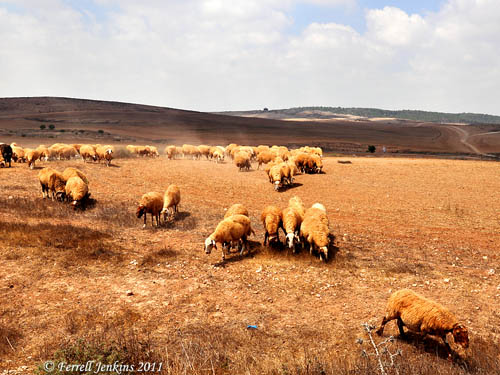
Our photo today was made a few miles north of Beersheba. I think it illustrates the typical dryness of the region.

Sheep in the Negev. Photo by Ferrell Jenkins.

Sheep in the Negev. Photo by Ferrell Jenkins.

Wednesday, November 16, 2011

Practicing the Attitude of Gratitude | Michael Hyatt

Practicing the Attitude of Gratitude | Michael Hyatt:

'via Blog this'

PRACTICING THE ATTITUDE OF GRATITUDE

Several years ago, at the encouragement of a friend, I started carrying a gratitude rock in my pocket. It’s really just a small, smooth stone that I picked up from the fish pond behind our house. I carry it with me where ever I go.

A Stone in a Hand - Photo courtesy of ©iStockphoto.com/jaminwell, Image #12120864

Photo courtesy of ©iStockphoto.com/jaminwell

The idea is simple. Whenever my hand contacts the stone–usually several times a day–I give thanks for whatever is happening at that moment, whether good or bad.

It is amazing how this simple act changes my perspective and, ultimately, my attitude. Instead of seeing the glass half-empty, I see it half-full. Instead of focusing on what I don’t have, I focus on what I do have–right now.

Someone once wisely told me, “You won’t get what you don’t have until you learn to be grateful for what you do have.” I think that is so true. We so often focus on our lack–what’smissing.

For example, we complain about our lack of a vibrant, real relationship with God. We wish our church were bigger–or smaller. We wish we had a spouse. Or perhaps we wish we didn’t have a spouse. Or maybe we want to change our spouse.

Or we wish we could get a different job, a different boss, or a bigger paycheck. We wish we had more interesting work, more sensitive coworkers, or different hours.

We wish we could live in a different city, a different part of the city, or a different house. We complain about our furniture, our car, and all our other stuff.

To state the obvious, this is not healthy. And do we really think this complaining spirit will lead to better relationships or more abundance?

I’ve always given thanks when I pray, but often it’s just perfunctory. Now, I am trying to give thanks more deliberately. The gratitude rock is one tool that is helping me.

Let me challenge you to push the pause button and write down twenty items you are thankful for right now. Here’s my list:

My Gratitude List

  1. My relationship with God
  2. His constant presence with me and blessings in my life
  3. My relationship with Gail
  4. Thirty-three years of marriage
  5. Gail’s constant support and encouragement
  6. Gail’s wisdom and timing
  7. Gail’s incredible parenting skills
  8. Gail’s sense of humor and her incredible servant’s heart
  9. Our home and the joy of sharing it with others
  10. My daughters and sons-in-law and the varieties of their personalities
  11. Their love for Gail and for me
  12. My grandchildren, who always make me smile
  13. The joy of laughing with Gail and the family
  14. The little town of Franklin and the fun of being able to walk to almost everything
  15. This new season of my life, where I am living my dream of speaking and writing
  16. The fact that I have enough to eat today
  17. Dark chocolate
  18. The fact that I am warm, dry, and comfortable
  19. The fact that I am healthy and able to exercise regularly
  20. My church and the the people I have worshipped with for twenty-seven years

Keep your lamps burning | Ferrell's Travel Blog

Keep your lamps burning | Ferrell's Travel Blog:

'via Blog this'

Keep your lamps burning

Light is necessary for life and growth. We are introduced to light in the biblical account of creation.

And God said, “Let there be light,” and there was light. And God saw that the light was good. And God separated the light from the darkness. God called the light Day, and the darkness he called Night. And there was evening and there was morning, the first day. (Genesis 1:3-5 ESV)

Of Jesus, the Gospel of John says, “In him was life, and the life was the light of men” (John 1:4 ESV).

David spoke of meditating on God during the watches of the night (Psalm 63:6). He watched his sheep by night, but most work was not done in the night prior to the introduction of electric power. We used one Aladdin lamp and a few kerosene lamps in our home in the rural South until I was about 8 or 10 years old. Then we began to use a single electric bulb in a room when we needed to be in the room.

Jesus said,

We must work the works of of him who sent me while it is day; night is coming, when no one can work. As long as I am in the world, I am the light of the world” (John 9:4-5 ESV).

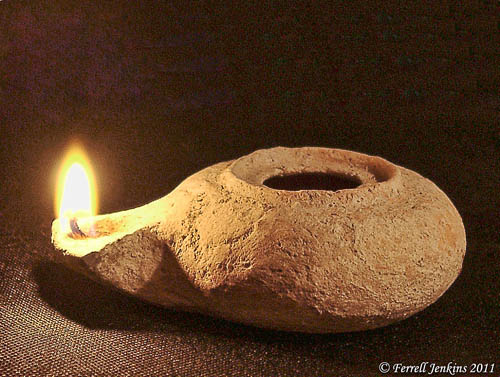
Herodian period lamp burning. Photo by Ferrell Jenkins.

Herodian period lamp from the time of Jesus. Photo by Ferrell Jenkins.

The photo above is one of the Herodian period lamps I have purchased in the Bible lands over the past 44 years. Two or three times I have used some olive oil (or Wesson oil, or a small piece of a candle) to show how much light the lamp gives.

In the parable of the watchful slaves Jesus said,

“Stay dressed for action and keep your lamps burning, and be like men who are waiting for their master to come home from the wedding feast, so that they may open the door to him at once when he comes and knocks. (Luke 12:35-36 ESV)

The Apostle Paul commanded the saints at Philippi to shine as lights in the world.

Do all things without grumbling or questioning, that you may be blameless and innocent, children of God without blemish in the midst of a crooked and twisted generation, among whom you shine as lights in the world, (Philippians 2:14-15 ESV)

Monday, November 14, 2011

Eternal Value


And he said to them, "Take care, and be on your guard against all covetousness, for one's life does not consist in the abundance of his possessions." 
Lk 12:15 


As "things" surround us, it is hard to get away from them to see those things that are truly valuable.  A number of years ago, a woman who had turned 100 years old, was asked what she thought the best invention of her century had been - the refrigerator, dishwasher, automobile? After a few moments, she responded "running water."  Wow!  Talk about losing perspective on value. This is exactly what Jesus is referring to in the passage above. Life is much more than what we accumulate.  In another instance after an intruder had broken into a home, police arrived and were trying to figure out what the intruder was after. The officer asks the owner of the home “Do you have anything of value in your house?”  Without hesitation, she replied, “Yes, my nine year-old daughter.”


What would be your response? Some jewelry? A plasma-screen TV? Your new computer? An irreplaceable family heirloom?

God wants us to focus on things that have eternal value. The people in your life have eternal value. The things you own do not. Your soul has eternal value. Wisdom has eternal value, as does love, peace, humility, patience, kindness and much more. 

As you think about these things, will you change the way to relate to any of them? How about your annoying neighbor or insensitive co-worker? Will knowing their eternal value change the way you relate to them?  People are not things - they are souls that have an eternal value before God.  It changes our perspective, when we understand that by letting things like humility, patience, kindness, etc go and coveting things, that we could by our reaction cause another soul of eternal value to be damaged. 


"But I say to you who hear, Love your enemies, do good to those who hate you, bless those who curse you, pray for those who abuse you."
Lk.6:27,28 


Jim


Monday, November 7, 2011

The "Eternity Test"


"Do not lay up for yourselves treasures on earth, where moth and rust destroy and where thieves break in and steal, but lay up for yourselves treasures in heaven, where neither moth nor rust destroys and where thieves do not break in and steal. For where your treasure is, there your heart will be also."  
Matthew 6:19-21


We have enough going on in the world around us without having to worry about small things too. Yet, it often becomes the small things that distract us the most. We get hit by winds of lifestyle, waves of financial and people pressure, along with tremors and quakes of day to day stress. It is hard to find rest, much less contentment in life when all of this goes on around us every day.

Our verse above, Jesus teaches that the perspective of our heart will determine the things of value in our lives. It becomes what we manifest. When my focus is on things, toys, this life, things that are corruptible and belonging  to this world - then I will ever be chasing the rainbow! There will never be enough, there will always be anguish, there is never an end. And then, if I get to the point of receiving what I have longed for, I get it only to find that it only lasts for "x" years, or I have to renew it, or someone changes the rules of the game. 

The real secret to becoming content is to focus on the things that have eternal value. It may be a familiar teaching to you, but Jesus said we should store up our treasures in heaven - the spiritual things, not on earth, “where moth and rust destroy, and where thieves break in and steal” (Mt 6:19-21) the physical things. 


Think about the things in your life:

  • What are you chasing after?
  • Will it/they last forever?
  • Will last at least for your lifetime?
  • Will it/they last a few short years, months, or days?

Here's an important consideration. If you give the things that swallow your current life an "eternity test" do they last? With that perspective, which things become most important? Where — and with whom — should you put most of your time and energy?  Reorganize your life around eternal priorities and purposes, and you’ll find yourself growing in contentment as well. 


Everything you were taught can be put into a few words: Respect and obey God! This is what life is all about.  Eccl. 12:13 CEV


Jim

Tuesday, November 1, 2011

Trusting God

“Trust in the Lord with all your heart and lean not on your own understanding; in all your ways acknowledge him, and he will make your paths straight.”
 Proverbs 3:5-6 (NIV)

Life is full of challenges, ups and downs. There are many times that we don't know which way to turn or what choice to make - and from our point of view everything seems to lead to a dead end. Financial, emotional, relational it doesn't matter. When we are in the labyrinth of life, it is hard to see our way out. 

Proverbs 3 quoted above tells us that it is in times like this that if you will trust God even when you don’t see a way, He will make a way. Sometimes it is not the way that WE think it should be, it may even be in a completely different direction than we are heading. Fortunately, understanding is understanding is not a requirement for you to start down the path God lays before you. In fact, the Proverb tells us not to lean or trust our own understanding, because if we do that we are trusting ourselves (who may have just made a mess of things) and not God. It says to "acknowledge" God - not just to admit that there is a God and that He is there, but to KNOW God. This means to look for Him, see what He is doing in your life, and trust His guidance. It means that you and God are "friends!"

One day we will stand in the full light of eternity and view the big picture. We will be able then to see God’s purpose behind the path He specifically chose for us. In the meantime we have to be patient. God knows what He’s doing and what is best. He can see what we cannot - the end result. The problems, heartaches, difficulties and delays -- all the things that make you and I ask “why” -- God knows. And the scripture is replete with examples of those who in their circumstances trusted God and came out the better for it. 

If your circumstances seem overwhelming, have you trusted God lately?  Proverbs 4:18 says, “The path of the righteous is like the first gleam of dawn, shining brighter till the full light of day.”  Maybe it is time to give God the reins and TRUST Him.

Jim