Search This Blog

Saturday, July 9, 2011

BiblePlaces Blog: Excavation Report of Possible Tomb of Maccabees

BiblePlaces Blog: Excavation Report of Possible Tomb of Maccabees

Excavation Report of Possible Tomb of Maccabees

Has the family tomb of the Maccabees been discovered? An Israeli archaeologist who studied a site near Modi'in answers positively. Thereport in Hadashot Arkheologiyot is rather long and somewhat technical. I have selected some of the more interesting sections.

Horbat Ha-Gardi – one of the sites identified with the Tomb of the Maccabees – is located c. 3 km northwest of the town of Modi‘in (Fig. 1), next to the settlement of Mevo Modi‘in and alongside a dirt track (the patrol road) leading north. The site looks out to the west toward the Shephelah and the Mediterranean Sea; to the east is Nahal Modi‘in, on whose eastern bank, opposite the ruin, the village of El-Midya is located.

[...]

The ruin consists of two sites (Fig. 2): the tomb of Sheikh Gharbawi (Fig. 3) and 18 m to the north, the remains of a magnificent structure (below), which the local villagers refer to as al-Qala‘a (the fortress).Horbat Ha-Gardi is the northern of three ruins; the other two being Khirbat Hammam and Kabur el-Yahud (Tombs of the Jews), which extend across the ridge that borders Nahal Modi‘in on the west (see Fig. 1).

[...]

The myth of the Maccabees, identifying ancient Modi‘in – the seat of the Maccabees, the place where the revolt against the Greeks broke out in 167 BCE and especially the family tomb where they were interred – attracted the first scholars of the Land of Israel to the region in the nineteenth century. What they had in mind was the tomb, described in detail in I Maccabees (13:27–30) and in the writings of the Jewish historian Josephus of the first century CE, in Antiquities of the Jews(XIII, 211–213). The church fathers Eusebius and Hieronymus also describe Modi‘in and the tomb monument. The tomb also appears on the Madaba Map of the sixth century CE. We know from historical sources that Modi‘in was situated close to Lod (Diospolis), on the main road leading from the Shephelah up to Jerusalem.

[...]

Clermont-Ganneau did not rule out the possibly that unequivocal evidence will be found in the future, indicating that the site is the burial place of the Maccabees. He also added that “this structure was probably built by the Christians to commemorate the burial place of the holy Maccabees.”

Lieutenant Claude Reignier Conder visited the site in 1873 on behalf of the Palestine Exploration Society. He was impressed with the structure and declared that he had never seen a building identical to this in his explorations around the country (C.R. Conder 1873. Jerusalem and El Midyeh. PEQ 5:94). He returned to the site in 1874, accompanied by Charles Tyrwhitt Drake, an English scholar who was also a member of the British research expedition. Drake, who sketched a reconstruction of the tombs, stated decisively, “In my opinion there is no doubt that these are the tombs of the Maccabees” (T. Drake 1874. Mr. Tyrwhitt Drake’s Report. PEQ 6:78).

[...]

It should be noted that modern scholars tend to identify Horbat Ha-Gardi with the family burial compound of the Maccabees, or at least with the spot where the grave was marked in the Byzantine period; however, this determination is a wishful thinking, based on circumstantial evidence rather than on clear archaeological findings.

[...]

The task of the current expedition was to relocate the structure, which was exposed by the nineteenth-century scholars and inspect its remains. The illustrations and maps prepared by GuĂ©rin and Clermont-Ganneau aided in locating the magnificent structure relative to the sheikh’s tomb and the eastern burial chamber inside it (No. 1).

[...]

The nature of the structure and its dating are still unclear. Although the test was superficial and limited and did not include a proper archaeological excavation, methodological assumptions, some of which had already been raised in the past, can be introduced, based on the test and an analysis of the findings.
1. The dimensions of the structure are much larger than those revealed by the nineteenth-century scholars; they include additional sections that extend across an area of 6 dunams, although it is not yet clear if these sections belong to one complex or to a single period.
2. The quality of the construction and the size of the funerary structure are uncommon in ancient architecture and are unparalleled in the tombs known at Modi‘in and its vicinity, testifying to its importance....The remains can evince a tomb of magnificent splendor, built according to the best Jewish tradition, i.e., a rock-hewn tomb, a patrimony in which changes were made over the course of generations.

[...]

8. The size of the site, its plan, location, the nature of its construction and the architectural elements incorporated in it, are consistent with the descriptions of the tomb that appear in the Book of Maccabees and in Josephus.

The circumstantial archaeological evidence underlines the possibility of identifying Horbat Ha-Gardi with the family tomb of the Maccabees, or at least with the marking of the tomb in the Byzantine period. A proper and systematic archaeological excavation of the site will provide answers that either confirm or refute the identification of the site.

The report includes 20 illustrations including a location map, a site plan, and the author’s reconstruction of the structure.

Has the Term “Biblical” Lost its Meaning? | Bible Gateway Blog

Has the Term “Biblical” Lost its Meaning? | Bible Gateway Blog

Has the Term “Biblical” Lost its Meaning?

Do you identify yourself as a “Christian?” Maybe you prefer the term “evangelical”—or what about “Christ-follower” or “believer?”

Each of these labels means the same thing, more or less—but each has a slightly different emphasis. Several years ago, phenomena like the emerging church and trends in American politics prompted discussions about whether labels like “Christian” and “evangelical” had lost their usefulness as descriptors. Were they too broad and vague? Were they too closely associated with specific political views, or with off-putting stereotypes?

Those terms are all still in common use, but such discussions provoked a lot of healthy reflection about the power of labels—and the importance of using language carefully and accurately, particularly in the context of religion and Christianity. I felt similarly challenged recently when I read a blog post by James McGrath questioning whether the term “biblical” has similarly lost its usefulness through overuse.

McGrath takes particular issue with the application of the word “biblical” to certain political factions. But whether you agree with that angle or not, I think he has a point in that we attach the word “biblical” to so many different things that its meaning has become diluted—if it ever had a single specific meaning to begin with.

What do you mean when you describe something as “biblical?” Here are a few different senses in which I’ve seen “biblical” used:

  • to refer to the actual text of the Bible: “This biblical quote is taken from the book of 1 Corinthians.”
  • to describe an epic event: “It was an earthquake of biblical proportions.”
  • as a general synonym for “Christian,” with a slight emphasis on appreciating the Bible: “He recently joined a biblical church across town.”
  • to describe something derived from, or referring to, the text of Scripture:“That was a very biblical sermon you preached last Sunday.”
  • to describe (usually conservative) politics or views about society: “This politician is running on a biblical platform.”
  • To mean “in adherence to God’s law.” “She tries to lead a biblical lifestyle.”

You can probably come up with more examples. I think most Christians would commonly define “biblical” as meaning something like the last item listed above:in agreement with the teachings of the Bible. But as McGrath notes, even that is a very broad use of the term. The Bible, after all, is a collection of many different pieces of ancient literature, each of them written with a specific message and to a specific audience.

Certainly, Christians believe that the Bible is a unified, coherent text—but the themes of (for example) Leviticus, Esther, and Matthew are distinct enough that using a single word to encompass them all is tricky. If you say you’re trying to live a “biblical” lifestyle, does that mean you’re living in accordance with Old Testament laws, the New Testament covenant, or an overarching principle that underlies them both? Different people hearing the phrase will jump to different conclusions.

What do you mean when you say “biblical?” Does the term still imply a direct connection to Scripture, or has it become a broader synonym for “Christian” or “godly?”

BiblePlaces Blog: AP Profile of Excavations of Philistine Gath

BiblePlaces Blog: AP Profile of Excavations of Philistine Gath

AP Profile of Excavations of Philistine Gath

Excavations of the Philistine city of Gath (Tell es-Safi) began this week, and Associated Press writer Matti Friedman visited the site with photographer Ariel Schalit. Their profile of the site’s importance and its connection to the Philistines in history is well-written. Fromthe article’s conclusion:

One intriguing find at Gath is the remains of a large structure, possibly a temple, with two pillars. Maeir has suggested that this might have been a known design element in Philistine temple architecture when it was written into the Samson story.

Diggers at Gath have also found shards preserving names similar to Goliath — an Indo-European name, not a Semitic one of the kind that would have been used by the local Canaanites or Israelites. These finds show the Philistines indeed used such names and suggest that this detail, too, might be drawn from an accurate picture of their society.

The findings at the site support the idea that the Goliath story faithfully reflects something of the geopolitical reality of the period, Maeir said — the often violent interaction of the powerful Philistines of Gath with the kings of Jerusalem in the frontier zone between them.

“It doesn’t mean that we’re one day going to find a skull with a hole in its head from the stone that David slung at him, but it nevertheless tells that this reflects a cultural milieu that was actually there at the time,” Maeir said.

The full story is here. Larger versions of the seven photographs may be found here.

HT: Joseph Lauer

Gath, Tell es-Safi, from north, tb022807582

Gath from the north


Sunrise on the Sea of Galilee – May 4, 1968 | Ferrell's Travel Blog

This is a great post and pic by Ferrell Jenkins

Sunrise on the Sea of Galilee – May 4, 1968 | Ferrell's Travel Blog

Sunrise on the Sea of Galilee – May 4, 1968

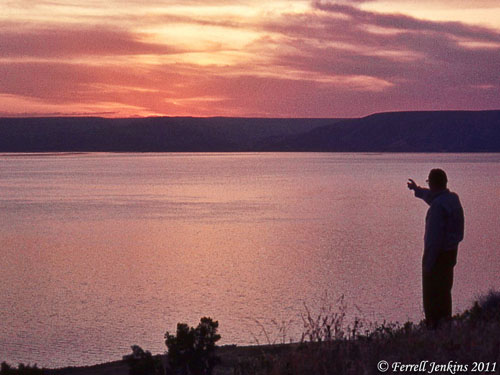
On my second tour to Israel in 1968 my group stayed at the Guberman Hotel in Tiberias. My room mate and I set our alarm for Saturday, May 4, in time to go down the hill to get an unobstructed view of the Sea and the sunrise to the East. This slide was made on Agfachrome.

Sunrise at the Sea of Galilee. May 4, 1968.

Sunrise at the Sea of Galilee - May 4, 1968.

Over the years I have made numerous similar photos. I always think about Jesus meeting His disciples after the resurrection on the shore of the Sea of Galilee and eating breakfast with them.

4 Just as day was breaking, Jesus stood on the shore; yet the disciples did not know that it was Jesus.
5 Jesus said to them, “Children, do you have any fish?” They answered him, “No.”
6 He said to them, “Cast the net on the right side of the boat, and you will find some.” So they cast it, and now they were not able to haul it in, because of the quantity of fish.
7 That disciple whom Jesus loved therefore said to Peter, “It is the Lord!” When Simon Peter heard that it was the Lord, he put on his outer garment, for he was stripped for work, and threw himself into the sea.
8 The other disciples came in the boat, dragging the net full of fish, for they were not far from the land, but about a hundred yards off.
9 When they got out on land, they saw a charcoal fire in place, with fish laid out on it, and bread.
10 Jesus said to them, “Bring some of the fish that you have just caught.”
11 So Simon Peter went aboard and hauled the net ashore, full of large fish, 153 of them. And although there were so many, the net was not torn.
12 Jesus said to them, “Come and have breakfast.” Now none of the disciples dared ask him, “Who are you?” They knew it was the Lord.
13 Jesus came and took the bread and gave it to them, and so with the fish.
14 This was now the third time that Jesus was revealed to the disciples after he was raised from the dead. (John 21:4-14 ESV)

Tuesday, July 5, 2011

BiblePlaces Blog: Prison on Ruins of Herod’s Palace Opened Briefly

BiblePlaces Blog: Prison on Ruins of Herod’s Palace Opened Briefly

Those in Jerusalem this month have a rare opportunity to visit the Kishle prison inside Jerusalem’s Old City. For two thousand years, this site atop Jerusalem’s Western Hill has served the city’s rulers as a fortress and police station. King Herod’s palace was constructed on the site and guarded by three towers. After the Romans destroyed the palace, the Tenth Roman Legion placed their encampment on the site. The Ottoman rulers constructed the present prison in the 1800s, and the British occupiers continued its use. From 1948 to 1967 the Jordanians used the site as a police station, and the Israelis have followed suit. According to the AP article, the jail has never been open to visitors.

An old Turkish prison in Jerusalem is briefly opening to the public this weekend, allowing visitors a rare glimpse inside an infamous local landmark.

[...]

Israeli archaeologists dug underneath the Kishle a decade ago and found important remains dating back nearly three millennia, including walls built by King Herod and medieval facilities for dyeing fabric.

"On this tiny spot we have the whole story of Jerusalem, from the Judean kings to the British mandate," said Amit Re'em, the Israel Antiquities Authority archaeologist who excavated the Kishle.

The prison sits next to the Tower of David, an ancient fortress on the western flank of Jerusalem's Old City. The tower complex, used as a stronghold and palace by Herod, early Muslim rulers, Crusaders and the Jordanian army, among others, is now a museum dedicated to Jerusalem's history.

The full story is here.

If I was in Jerusalem this month, I’d get a group together and hire an expert like Gabriel Barkay or Shimon Gibson to give an archaeological tour.

HT: The Bible and Interpretation

Police station Kishleh in Armenian Quarter, tb042403893

Kishle police station from north


Monday, July 4, 2011

Herding Cats and Managing Chaos

I had a fun discussion this past week, with someone about their position in management. Their summation of their job was "trying to manage chaos."  A most interesting description, almost like one I heard just recently when a person muttered that what they did was like trying to herd cats.

Life is a confusing thing and definitely not for wimps. It has many challenges and sometimes the directions are not certain.  And sometimes, reading the manual doesn't help.  I got an item just recently that came with "assembly" instructions, that may as well have bee written by someone trying to create a crossword puzzle. I had chaos in front of me and part 2A looked almost identical to part 10c and the diagram was so small, that you couldn't tell what went where.


We all face dead ends at times, whether financial, emotional, or everyday life. We're not certain where to turn, what decision to make, etc.  Prov.3:5,6 states, “Trust in the Lord with all your heart and lean not on your own understanding; in all your ways submit to him, and he will make your paths straight.”  We must learn that trusting God is the best way, even if we cannot always see the outcome and are not sure within ourselves.  We must stick to what we know to be true (1 Pet.3:13) and trust God to reveal to us the rest in His own time and according to His own will.

Sometimes, understanding is not a requirement for us to start down the path God lays out for us. Proverbs 4:18 says, “The path of the righteous is like the first gleam of dawn, shining brighter till the full light of day.” (NIV)  We may not even understand until we make it to eternity. But the events, circumstances, and happenings in my life are not coincidence, chance or "luck." We are where we are, doing what we are doing for a reason. One day you will stand in the full light of eternity and view the big picture. You’ll see God’s purpose behind the path he specifically chose for you and then state, "ah...now I understand."

In the meantime, be patient. God knows what He’s doing and part of your circumstance is to see if you trust God in this. God knows what is best for you. He can see the end result, you cannot. All those problems, heartaches, difficulties and delays—all the things that make you ask “why”—one day will all be clear in the light of God’s love. Until then, "Psa 23:4  Even though I walk through the valley of the shadow of death, I will fear no evil, for you are with me; your rod and your staff, they comfort me."

Jim 


Friday, July 1, 2011

The diolkos of ancient Corinth | Ferrell's Travel Blog

The diolkos of ancient Corinth | Ferrell's Travel Blog

The diolkos of ancient Corinth

Surely a greater percentage of tourists who have visited ancient Corinth have stopped at the Corinth Canal for a photograph. The canal was constructed between 1881 and 1893. A much smaller number probably recall that there was an ancient paved road, called the diolkos, on which smaller boats could be dragged across the isthmus.

Ancient Diolkos Sign. Photo by Ferrell Jenkins.

Ancient Diolkos Sign. Photo by Ferrell Jenkins.

Pettigrew (Corinthian Matters) says that Strabo uses the term diolkos of the narrow land strip, rather than a physical road.

Interestingly, the modern use of the term “diolkos“ is one of the great misnomers of modern scholarship. Strabo uses the word in a geographic sense to describe a land strip visible from Acrocorinth and equivalent to the narrowest part of the Isthmus. No one in antiquity associated the term with the physical road.

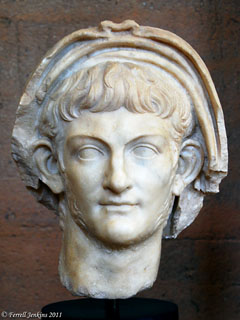
Bust of Neo. Corinth Museum. Photo by Ferrell Jenkins.

Bust of Neo. Corinth Museum.

The cargo of larger ships was unloaded and carried across the isthmus and reloaded. Ships that could be dragged across the land bridge avoided the 200 mile journey around the Peloponnesus. Nero abandoned his attempts to dig a canal across the isthmus in A.D. 67. Josephus records that 6,000 of the strongest men involved in the Galilean revolt were sent to Nero, “to dig through the Isthmus [of Corinth]” (JW. 3.540).

David Pettigrew recently spent two days touring the diolkos. He includes some nice photos (here) that are large enough for use in presentations. He also includes a plan allowing identification of each photo.

Yesterday I received a new scanner and decided to pull out my old slides of thediolkos. The date is so faded on the slide frame that I am unable to read it. I think the photos were made in the early 1970s. Compare this will Pettegrew’s recent (first) photo of the same area.

Diolkos Sign and a portion of Sector G. Photo by Ferrell Jenkins.

Diolkos Sign and a portion of Sector G. Photo by Ferrell Jenkins.

Here is a closer view of the same sector. In Pettegrew’s photos this area has been cleared of dirt to show more of the paving.

Diolkos Sector G. Photo by Ferrell Jenkins in 1970s..

Diolkos Sector G. Photo by Ferrell Jenkins in the 1970s.

Below is my photo of Sector E from the early 1970s. Compare with Pettegrew’s photo (which appears to have been made earlier than his other photos). Leon Mauldin has a photo made in early 2010 here.

Diolkos - Sector E in the 1970s. Photo by Ferrell Jenkins.

Diolkos - Sector E in the 1970s. Photo by Ferrell Jenkins.

Dr. Pettegrew was able to visit Sector K, the only section on the north side of the Corinth canal. His post documents the damage being done to the diolkos by ships passing through the Corinth canal. In addition to the new photos here, he has a section dealing with the diolkos under the heading Isthmus.

The diolkos was in use during the time Paul was at Corinth. The commercial benefit to Corinth, as well as to the port cities of Lechaion and Cenchrea, was significant.

And he stayed a year and six months, teaching the word of God among them. (Acts 18:11 ESV)

In addition to the video’s at Corinthian Matters, there is one here featuring comments by Sophia Loverdou.